

0





| Thumbs Up/Down |
| Received: 216/3 Given: 92/2 |

Aryans/Indo-Europeans were always a small minority of rulers, and we can see that in every people of Indo-European origins.
An example is in the satem languages, here's a post of mine in another forum:
"WESTERN IRANIC-SPEAKING GROUPS:
Iraqi Kurds:
J2 - 28.4%
R1b - 16.8%
R1a - 11.6%
G - 4.2%
Turkey Kurds:
J - 20%
R1a - 19,5%
R1b - 6%
G - 4%
North Iranians:
R - 27,27%
J2 - 24%
G - 15,15%
South Iranians:
R - 25,64%
G - 25,64%
J2 - 23%
Balochi:
R1a - 28%
J - 16%
R1b - 8%
EASTERN IRANIC-SPEAKING GROUPS:
Yaghnobi:
J - 32%
R1b/R1 - 32%
R1a - 16%
Tajiks:
R1a - 44,7%
J - 18,4%
Pamiri:
J2 - 6,1%
Southern Afghanistan Pashtuns:
R1a1a - 66,8%
G2 - 8,2%
J2 - 4,8%
R1b1b2 - 0,6%
Northern Afghanistan Pashtuns:
R1a1a - 50%
G2 - 7%
J2 - 4,5%
North-Ossetians (Iron):
G - 74,3%
J2 - 18,3%
R1b - 3%
R1a - 0,4%
North-Ossetians (Digor):
G - 60,6%
R1b - 16,5%
J2 - 11,8%
R1a - 0,8%
INDO-ARYAN-SPEAKING GROUPS:
Pakistani:
R1a - 24,4%
J - 15,3%
R1b - 7,4%
G - 6,2%
Indian IEs:
R1a - 29,8%
J - 10,7%
R1b - 1,5%
G - 0,5%
ISOLATED IE GROUPS IN SOUTH ASIA
Kalash:
G - 18,2%
R1a - 18,2%
J2 - 9,1%"
.
| Thumbs Up/Down |
| Received: 216/3 Given: 92/2 |
.
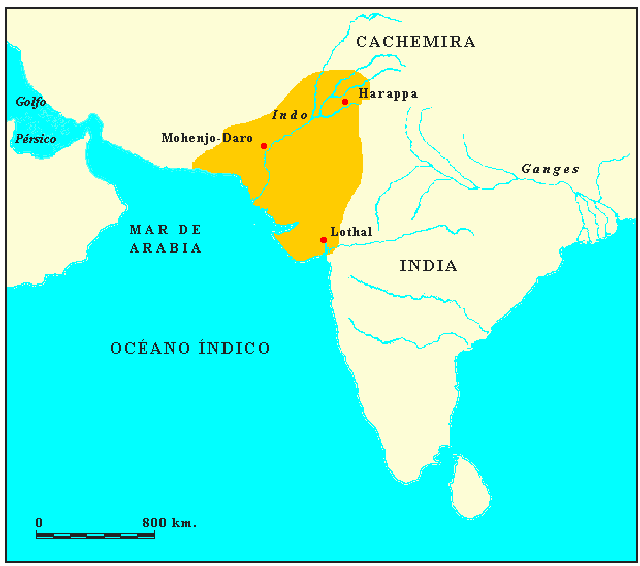
I personally believe thath Multan-Lahore (Indo Valley) civilization was the uhremeit of the Indoeuropeans people: take a look of the position...this would also explain why pseudo/para-white people are also diffused in the surrounding areas.
Indo Valley civilization was very advanced, with lost knowleges and a mysterious end.
| Thumbs Up/Down |
| Received: 216/3 Given: 92/2 |
Originally Posted by Perduellio

I do not necessarily think that it was the "Urheimat", but it was surely IE. I agree with you.
.
| Thumbs Up/Down |
| Received: 216/3 Given: 92/2 |
Harappans were IE: http://www.dnatribes.com/dnatribes-d...2012-04-02.pdf
Indus Valley language is Aryan: My book Sanskrit Eloquent Indus Seals conclusively proves based on rigorous logical arguments that the language of the ancient Indus Valley is Sanskrit. The following text is from the Ebook,
Sanskrit Eloquent Indus Seals by R V Muraleedharan
An Indus Seal with 4 symbols and 30 readings
I have selected an Indus seal that was unearthed from the Indus Valley site of Kalibangan in the state of Rajasthan in India. The seal is mostly engraved with symbols of numerals that could be given uncontroversial phonetic values. The seal depicts a milieu of three characters, a man, a strange animal and a tree. The scene has many oddities that seem to be deliberately incorporated by the seal maker so that the depiction may conform to the text written on the seal.
1) A man sits on a tree. 2) The man has an unusually narrow belly. 3) The man sits with his legs crossed. 4) He sits on a leaf of the tree. 5) He raises his hand. 6) The strange animal has human-like face and legs.
In spite of the complexity of the depicted scenery the scripts on the seal are relatively simple; a human figure with additional markings on the body, 7 strokes and another 3 strokes. For now, we will neglect the additional markings on the human figure. Fortunately, the three symbols are clear-cut and noncontroversial; 3, 7 and a man. Though there are many terms for the word ‘man’ in Sanskrit, we will choose the most commonly used term mAnusha, of which man is a shortened English form. The combination of English terms (from the right to the left)
3 + 7 + man
three + seven + man
This, in Sanskrit, adds up as:
thra + sapta + mAnusha
(thra = 3; sapta = 7; mAnusha = man)
1) Sanskrit Reading: tharu sambaddha mAnusha
Meaning of Sanskrit words: (tharu = to a tree; sambaddha = attached; mAnusha = a man)
English Translation of the reading : A man attached to a tree.
2) Sanskrit Reading: udara sambAdha mAnusha
Meaning of Sanskrit words: udara = belly; sambAdha = narrow; mAnusha = man
English Translation of the reading: A man with a narrow belly.
The above scripts can be read in the reverse order too!
The combination of symbols in Sanskrit is:
mAnusha + sapta + thra
(mAnusha = man; sapta = 7; thra = 3)
........ Cont’d............
6) Sanskrit Reading: mAnushasya pAda thAra
Meaning of Sanskrit words: (mAnushasya = man’s; pAda = legs; thAra =crossing)
English Translation of the reading: Man’s legs are crossing.
7) Sanskrit Reading: mAnusha Asya pAda thAra
Meaning of Sanskrit words: (mAnusha = man; Asya = sits; pAda = leg; thAra = crossing)
English Translation of the reading: Man sits with legs crossed.
The vestiges of these ancient Sanskrit terms in modern English can be attested by reading the above symbols as “tree’s bound man” and “trans-foot man”!
We will now take into account the neglected extra markings on the human figure and examine how this changes the reading. The man seems to carry an open rectangular structure on his shoulders. The ingenuity of the script writer is manifested here. The man on the tree has his palm raised up; likewise the human figure in the script lifts up a contraption on his shoulder. The contraption looks like the beam of a balance. In Sanskrit the palm of the hand is called tAla. The prefix ud in Sanskrit denotes motion upwards. Adding this to the noun tAla, the term uttAla means the palm lifted up. A balance or the beam of a balance is termed by the word tola, rhyming with tAla, the palm. Following similar arguments, uttola denotes a lifted up balance or a beam of balance the man is depicted to hold.
........ Cont’d............
Well, in fact the above reading is true to the last letter! If you observe the Monster’s face closely you will find that there are holes around the neck suggesting that its face is indeed an attachment! The presence of the holes is confirmed in the next reading!
24) Sanskrit Reading: uttAla mAnusha Asyah bhiddha dhara
Meaning of Sanskrit words: (uttala = monster; mAnusha = man; Asyah = face; bhiddha = dissected; dhara = bears)
English Translation of the reading: The monster bears a dissected human face
We have, in fact, covered most of the peculiarities of the pictorial depiction encoded by the script of the seal. But there are still other readings that are not figuratively portrayed.
25) Sanskrit Reading: tAla mAnusha shabda dhara
Meaning of Sanskrit words: (tAla = palm-leaf; mAnusha = man; shabda = voice; dhara = bears)
English Translation of the reading: The palm-leaf bears man’s voice
........ Cont’d............
Now we will try to get a glimpse of the practical application of the seal. Apart from captioning the accompanying picture, does the script signify anything? The Harappan archaeologists claim that the seals are used to seal the goods produced in the Indus Valley. These seals, therefore, encode the identity of its owners. If we assume such a theoretical possibility does the above seal contain the identity of any person? Yes, there is an ancient name homophonous to uttAla mentioned in Mahabharata.
(From Adiparvam, Mahabharata)
yasmAd bhavAn kedArakhandam avadAryotthitas tasmAd bhavAn uddAlaka eva nAmnA bhavishyatIti
Translation: Since you have erected a dyke, you will be named Uddalaka.
28) Sanskrit Reading: uddAla mAnusha sampat dhara
Meaning of Sanskrit words: (uddAla = the name of a man; mAnusha = man; sampat = property, goods; dhara = bears)
English Translation of the reading: Carrying the goods of the man, Uddala.
........ Cont’d............
We read an obscure Indus seal scribbled with 2 numerals and 2 symbols in 30 different ways! This is proof enough that the Indus script is eloquent, and that too in the Aryan tongue of Sanskrit!
http://www.readindus.com/
.
I think instead that this was the true origins: this civilization ended in 2500 B.C. circa...after this, probabily indoeuros migrated to the north, in the ancient North Caucasus/Volga regions, and after they widespread into all Europe and Caucasus, plus Anatolia; this would explain why legend talk about people "came from North" (doric, hittites,etc.).
Another group remained in the area and formed modern pakistani and indians indoeuropean speakers (Pashtuns, Khalas, Punjabi, etc), while others formed the proto-iranid people.
I personally don't believe in Von Sebottendorf and Hitler theories about an ancient "north euro civilization", because there aren't any material, historical and mythological evidence of this theory.
| Thumbs Up/Down |
| Received: 13/14 Given: 0/0 |
That is just wishfull thinking.As i have already said all facts point a migration from Central-Eastern Europe toward Asia not the other way around.
SourceThere's a new paper out at PNAS covering the origin and spread of horse domestication, as inferred from the DNA of living horses from across the Eurasian steppes. According to the authors, Warmuth et al., horses were first domesticated on the western steppe - what is now Ukraine, Southwest Russia and Western Kazakhstan. Apparently, the people responsible then migrated deep into Asia, possibly on horseback, and added wild horses to their herds as they moved.
That is Indo-Europeans were the first to use the horse in their expansion and warfare,and that gived them a lot of advantage.
| Thumbs Up/Down |
| Received: 216/3 Given: 92/2 |
^^ Yes, but where did those Indus Valley people come from? From the area of origin of J2 and G: Anatolia.
.
But this can work with my theory: the region you mentioned were the second stop of the indoeuropean proto euro people.
There are currently 2 users browsing this thread. (0 members and 2 guests)
 Posting Permissions

 Reply With Quote

Bookmarks