

0






| Thumbs Up/Down |
| Received: 1,297/53 Given: 3,160/211 |

Greeks are one of the most Neolithic and least IE peoples of Europe based on genetics.Originally Posted by Optimus

So claiming to the IE homeland in Central Asia or the Pontic Steppe is Nordicst is it?You really believe that uber-weiss aryan Vrill inhabited Northern Europe after Thule island sinking, and after they mixed with untermenschen, unless in ancient Germany, like Von Sebottendorf Nietsche and after Hitler (but also Madame Blavatsky theosophy) believed? I find this pseudo-science hard to believe, sincerely.
Yeah, that's right - because us Northern Euros just love Kazakhstan and the ubermensch aryans like Borat...
Sorry, but so far I haven't seen anyone claiming the IE homeland is Scandinavia so maybe you need to stop putting words in peoples mouths. Why are you bringing that daft north / south thing into this anyway?
Central Asia or India - neither are Europe and neither are very desirable as a homeland either.


| Thumbs Up/Down |
| Received: 216/3 Given: 92/2 |
Then is the opposite, Greeks are 26,4% J2 and G (=26,4% IEs).
.

| Thumbs Up/Down |
| Received: 12,275/315 Given: 7,988/459 |
I personally believe in the Kurgan hypothesis as described by the Lithuanian archeologist Marija Gimbutas, wich states that the Proto-Indo-Europeans came from the Pontic Steppe. It it nohow a "Nordicist" theory, at least as I see. It is more likely that the PIE were a more Mediterranoid-looking population than Nordish.

| Thumbs Up/Down |
| Received: 216/3 Given: 92/2 |
Marija Gimbutas' theory is by time unaccepted anymore.
.
| Thumbs Up/Down |
| Received: 1,297/53 Given: 3,160/211 |
Yes, how silly of us - of course regions which have never hosted farming or are unfarmable must have been settled by Neolithic farmers. Yes indeed, the Kola Peninsula, Sakhalin, the Tarim Desert, Northern Burkino Faso and Gujarat must all be absolutely teeming with J2 / G men.
This is the daftest argument yet. Follow the swatsikas is like saying follow the wind.
| Thumbs Up/Down |
| Received: 216/3 Given: 92/2 |
Obviously they spread also to non-IE people that came in contact with them. You can see two big sources for that: Middle East and India. Tarim desert has to do with it because the later mummies from 2000 years ao were J2 and G.
.
| Thumbs Up/Down |
| Received: 1,297/53 Given: 3,160/211 |
No, these haplogroups were in Europe before IE was. Only R1a and possibly R1b are Indo-European.
I1, I2 = native
N, G, J2, E = Neolithic farmers (likely speaking Afro-Asiatic, South Caucasian or something akin to Sumerian)
R1a, R1b = the latecomers, Indo-Europeans.
| Thumbs Up/Down |
| Received: 216/3 Given: 92/2 |
Totally wrong.
J2, G = Aryans Indo-Europeans
R1a, R1b, E, etc. = later Indo-Europeanized
.
| Thumbs Up/Down |
| Received: 216/3 Given: 92/2 |
The neolithic Anatolian origin of Indo-European languages
Evolutionary biologists have waded into the stormy debate over when and where Indo-European languages originated.
Dr Russell Gray and PhD student Quentin Atkinson from the University of Auckland in New Zealand have calculated this group of 87 languages – as diverse as English, Lithuanian and Gujarati – arose between 8000 and 9500 years ago.
Their findings were reported in today’s issue of the journal Nature and support the theory that Indo-European languages arose around this time among farming communities in Anatolia, now known as Turkey.
The main competing theory to the Anatolian farmer theory is that these languages originated 6000 years ago among nomadic Kurgan horsemen sweeping down from the Russian Steppes. Some researchers say they spread their language and genes across Europe “through the sword” and through the use of horses and horse-drawn vehicles, Gray told ABC Science Online.
“People have been puzzled since at least Sir William Jones noticed in 1786 that Sanskrit, an ancient language in India, bore striking similarities to Greek and to Latin and to English. Where did all those languages come from and when did they split up?” he asked. “What we’ve been doing is to try and answer that question and in particular to test the two current major views about the origins of the European languages.”
While evidence of horse-drawn wheeled vehicles supported the “power of the sword” Kurgan theory, Gray said the fact that certain genes become rarer as you get further away from the Turkish region supported the “much kinder, gentler” Anatolian farmer theory.
“People have had huge arguments about that,” said Gray, who decided to try and settle the question using a technique from a branch of research called molecular phylogenetics. This computational and statistical method compares genes and builds family trees by inferring when different biological organisms diverged during evolution.
“Language like biological species diverge with time,” Gray said.
Using vocabulary and grammar instead of genes, the researchers used the same method to build a “family tree” of Indo-European languages. This was the first time methods like these have been applied to finding the roots of Indo-European languages.
Gray said his study came up with a root date that agreed with the Anatolian farmer theory “unbelievably closely”. The researchers checked and double-checked their findings: “We did everything we could possibly think of, like changing different assumptions, to try and see if we could get a different date range.”
Evolutionary biologist Gray said the findings were bound to inflame rather than settle the debate and said there had been some “fairly vigorous responses” to the findings so far: “Some linguists have been fairly kind of agitated I guess, having people come in from the outside and saying look we can solve these problems.
http://mathildasanthropologyblog.wor...ean-languages/
.
| Thumbs Up/Down |
| Received: 1,297/53 Given: 3,160/211 |
Right, so that's Tarim - now how about Finnic Kola and Ainu Sakhalin? Oh, and Burkino Faso - how did they get there? Don't tell me the Berbers took them.
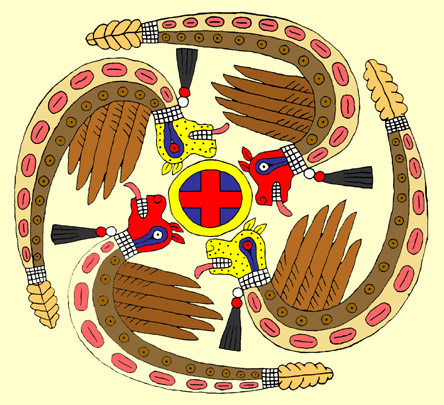
It is likely that in many places such a simple symbol developed independently. Some Mississippi native Americans did just that:
There are currently 1 users browsing this thread. (0 members and 1 guests)
 Posting Permissions


 Reply With Quote

Bookmarks