

0






| Thumbs Up/Down |
| Received: 1,297/53 Given: 3,160/211 |

I don't think anyone doubts that pastoralism developed in the Near East, but where people can settle to farm arable crops they will do.As I already mentioned such a thing as "The Middle Eastern flora and fauna" doesnt exist because the Near East is to diverse in this and has changed many times over time.
"Steppes/Grasslands " are the best places to se pastoralism. And the Near East is where pastoralism developed.
The Indo-Europeans were nomadic pastoralists until they settled in Europe and Southern Asia. The closest the Near East would have ever got to this would have been transhumance and a few goat herders in the mountains.
I already mentioned this when I mentioned Cappadocia.Look at this map here. Grasslands are not absent in the Near East at all, interesting enought Grassland is strong in the area of former Halaf Culture (fertile crescent)
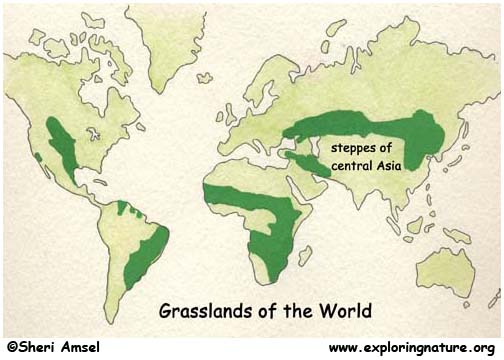
And this when I mentioned the Caucasus.Forests are also not absent in West Asia.

They adopted what they needed from the Cuceteni but being pastoralists there was a limit to how much they could adopt.I heard about that and this is the Group which I think they have adopted Indo European languages from. Why and how could they adopt so much of Neolthic lifestyle without being under the pressure to adopt also the language spoken bei the Neolthic groups to communicate with them.
The Yamn didn't adopt the language of the Cucteni because it was of little use to them, their societies were too different.
When the Cuceteni declined members of it may have adopted the Yamna way of life:
Cultures that rely on nomadic herding, where the livestock may be moved around to greener pastures freely, survive much better in arid regions than cultures that have permanent settlements that are based on subsistence farming techniques. With verified evidence that Kurgan pastoralists were living cheek-to-jowl with the Cucuteni-Trypillian settlements throughout their entire region for many centuries before the end of the Cucuteni-Trypillian culture, it is becoming very difficult to support Gimbutas' claim of a military conquest of a peaceful civilization. Rather, it is much more believable and logical to conclude that the members of the Cucuteni-Trypillian society that were facing starvation by farming their dry and barren plots of depleted soil chose instead to take up the practice of their neighbors, and became pastoralists instead.
| Thumbs Up/Down |
| Received: 13/14 Given: 0/0 |
This map is pretty obvious to me.
I am sorry but everyone arguing that WestAsian J2/G are the PIE-s need to check the psychiatrist.
| Thumbs Up/Down |
| Received: 1,297/53 Given: 3,160/211 |
They became isolated latter and are only isolated today because links to other languages are not known or have died out.This doesnt make much sense by any meanings. Neolthic expansion took place in an area where people are known to have spoken formerly "isolated languages"
All languages must ultimately have a common origin if people have a common origin.
We can assume that much of the Near East (including Levant) would have been Afro-Asiatic and South Caucasian speaking by then. Thus as neolithic farmers spread into Europe they'd have spread Afro-Asiatic and replaced earlier languages.
Sumerian is an isolate because we don't know languages it is linked to yet. Some people say Dravidian, but I find that hard to believe.
Isolates don't just appear out of nowhere, they become isolated via isolation and divergence, not because people wake up speaking a different language one day.
Yes, and thus Afro-Asiatic would very likely have been spread throughout much of Europe by Neolithic farmers.While Afro Asiatic languages where clearly introduced into West Asia (the northern part where Farming and Pastoralism developed) from an area somewhere between North Africa and the Levant and is associated with the spread of E1b1b* Haplogroup and came in contact with Neolthic Groups with the spread more into the Levant and Mesopotamia by taking some J* and G* lineages.
Earlier languages from the Mesolithic wouldn't have survived if the Mesolithic peoples adopted the way of life of the farmers that spoke Afro-Asiatic. However Basque and a few of the pre-IE languages could have been exceptions.
If we assume that Afro-Asiatic was the language of Neolthic farmers than we would have to assume that Neolthic lifestyle was introduced to West Asia through North Africa and the Levant, while it actually is the other way around and a strong Caucasoid input into Africa came from the Near East.The Horn of Africa, particularly the area of Ethiopia and Eritrea, has been proposed by some linguists because it includes the majority of the diversity of the Afroasiatic language family and has very diverse groups in close geographic proximity, sometimes considered a telltale sign for a linguistic geographic origin. Within this region there are several variants:
Christopher Ehret has proposed the western Red Sea coast from Eritrea to southeastern Egypt. While Ehret disputes Militarev's proposal that Proto-Afroasiatic shows signs of a common farming lexicon, he suggests that early Afroasiatic languages were involved in the even earlier development of intensive food collection in the areas of Ethiopia and Sudan. In other words, he proposes an even older age for Afroasiatic than Militarev, at least 15,000 years old and possibly older, and believes farming lexicon can only be reconstructed for branches of Afroasiatic.
In the next phase, unlike many other authors Ehret proposed an initial split between northern, southern and Omotic. The northern group includes Semitic, Egyptian and Berber (agreeing with others such as Diakonoff). He proposed that Chadic stems from Berber (some other authors group it with southern Afroasiatic languages such as Cushitic ones).http://en.wikipedia.org/wiki/Afro-Asiatic_UrheimatThe Levant/Near East. Supporters of a non-north or north east African origin for Afroasiatic are particularly common among those with a background in Semitic or Egyptological studies, or amongst archaeological proponents of the "farming/language dispersal hypothesis" according to which major language groups dispersed with early farming technology in the Neolithic.[13][14] The leading linguistic proponent of this idea in recent times is Alexander Militarev. Arguments for and against this position depend upon the contested proposal that farming-related words can be reconstructed in Proto-Afroasiatic, with farming technology being widely thought to have spread from the Levant into Africa.
Militarev, who linked proto-Afroasiatic to the Levantine Natufian culture, that preceded the spread of farming technology, believes the language family to be about 10,000 years old. He wrote (Militarev 2002, p. 135) that the "Proto-Afrasian language, on the verge of a split into daughter languages", meaning, in his scenario, into "Cushitic, Omotic, Egyptian, Semitic and Chadic-Berber", "should be roughly dated to the ninth millennium BC".
IMO Afro-Asiatic could have been spread by neolithic farmers to Europe. I don't see any contradictions yet.
| Thumbs Up/Down |
| Received: 1,297/53 Given: 3,160/211 |
There's a non-IE vocabulary in Celtic but also Germanic (although that could be Mesolithic - Finnic, Afro-Asiatic or some language group we don't know about).Originally Posted by Optimus

I'm not sure about the languages in Southern Europe but there were non-IE languages right into the Iron Age. I think some may have been very early offshoots of Afro-Asiatic.
The I haplogroup I've always thought of as native to Europe - Palaeolithic (Mesolithic in Northern Europe - we were recolonised after the Last Glacial Maximum).
I'm not sure how it would be Neolithic when it isn't really present outside of Europe.
| Thumbs Up/Down |
| Received: 1,297/53 Given: 3,160/211 |
Yes, that's where they began, but spread South to the Levant where haplogroup E speaking Afro-Asiatic could have assimilated these groups.
Then they spread with farming to Europe.
Some E in Europe could be directly from North Africa, some from the Levant IMO.
It's not hard to imagine - look at the Baltic peoples with their Finno-Ugric N haplogroup speaking some of the most archaic forms of IE.


| Thumbs Up/Down |
| Received: 216/3 Given: 92/2 |
THE WORDS DESCRIBING AGRICULTURAL TECHNOLOGY
We can learn more about the earliest Indo-Europeans from other aspects of their reconstructed vocabulary. Some words, for example, describe an agricultural technology whose existence dates back to 5000 B.C. By that time the agricultural revolution had spread north from its origins in the Fertile Crescent, where the first archaeological evidence of cultivation dates back to at least 8000 B.C. From this region agriculture also spread southward to sustain the Mesopotamian civilizations and westward to Egypt. The Indo-European words for "barley," "wheat" and "flax"; for "apples," "cherries" and their trees, for "mulberries" and their bushes; for "grapes" and their vines; and for the various implements with which to cultivate and harvest them describe a way of life unknown in northern Europe until the third or second millennium B.C., when the first archaeological evidence appears.
THE LANDSCAPE DESCRIBED BY THE INDO-EUROPEAN PROTOLANGUAGE
The landscape described by the reconstructed Indo-European protolanguage is mountainous—as evidenced by the many words for high mountains, mountain lakes and rapid rivers flowing from mountain sources. Such a picture cannot be reconciled with either the plains of central Europe or the steppes north of the Black Sea, which have been advanced as an alternative homeland for the Indo-Europeans. The vocabulary does, however, fit the landscape of eastern Anatolia and Transcaucasia, backed by the splendor of the Caucasus Mountains. The language clothes its landscape in the flora of this region, having words for "mountain oak," "birch," "beech," "hornbeam," "ash," "willow" or"white willow," "yew," "pine" or"fir," "heather" and "moss." Moreover, the language has words for animals that are alien to northern Europe: "leopard," "snow leopard," "lion," "monkey" and "elephant."
The presence of a word for "beech tree," incidentally, has been cited in favor of the European plains and against the lower Volga as the putative Indo -European homeland. Beech trees, it is true, do not grow east of a line drawn from Gdansk on the Baltic to the northwest corner of the Black Sea. Two species of beech ( Fagus orientatis and F. sylvatica) flourish, however, in modern Turkey. Opposing the so-called beech argument is the oak argument: paleobotanical evidence shows that oak trees (which are listed in the reconstructed language's lexicon) were not native to postglacial northern Europe but began to spread there from the south as late as the turn of the fourth to the third millennium B.C.
THE TERMINOLOGY FOR WHEELED TRANSPORT, SMELTING OF METALS
Another significant clue to the identification of the Indo-European home land is provided by the terminology for wheeled transport. There are words for "wheel" (*rotho-), "axle" (*hakhs-), "yoke" (*iak'om) and associated gear. "Horse" is *ekhos and "foal" *pholo. The bronze parts of the chariot and the bronze tools, with which chariots were fashioned from mountain hardwoods, furnish words that embrace the smelting of metals.Petroglyphs, symbols marked on stone, found in the area from the Transcaucasus to upper Mesopotamia between the lakes Van and Urmia are the earliest pictures of horse-drawn chariots.
.
| Thumbs Up/Down |
| Received: 13/14 Given: 0/0 |
SourceTo help unravel some of the early Eurasian steppe migration movements, we determined the Y-chromosomal and mitochondrial haplotypes and haplogroups of 26 ancient human specimens from the Krasnoyarsk area dated from between the middle of the second millennium BC. to the fourth century AD. In order to go further in the search of the geographic origin and physical traits of these south Siberian specimens, we also typed phenotype-informative single nucleotide polymorphisms. Our autosomal, Y-chromosomal and mitochondrial DNA analyses reveal that whereas few specimens seem to be related matrilineally or patrilineally, nearly all subjects belong to haplogroup R1a1-M17 which is thought to mark the eastward migration of the early Indo-Europeans. Our results also confirm that at the Bronze and Iron Ages, south Siberia was a region of overwhelmingly predominant European settlement, suggesting an eastward migration of Kurgan people across the Russo-Kazakh steppe. Finally, our data indicate that at the Bronze and Iron Age timeframe, south Siberians were blue (or green)-eyed, fair-skinned and light-haired people and that they might have played a role in the early development of the Tarim Basin civilization. To the best of our knowledge, no equivalent molecular analysis has been undertaken so far.
| Thumbs Up/Down |
| Received: 216/3 Given: 92/2 |
What's the link with what I linked above? That the mummies of 2000 B.C. were part of Afanasevo? Yes, it's very probable, but the mummies from 2000 years ago tell that they are J2 and G, and the Tocharian language is more linked to these later mummies, given that the language is documented by 600-800 A.D.
Read what I linked, there you'll find the definitive proofs of the Anatolian Hypothesis.
.
| Thumbs Up/Down |
| Received: 13/14 Given: 0/0 |
Or according to 2012 study.
SourceThe prevailing Y-chromosome lineage in Pashtun and Tajik (R1a1a-M17), has the highest observed diversity among populations of the Indus Valley [46]. R1a1a-M17 diversity declines toward the Pontic-Caspian steppe where the mid-Holocene R1a1a7-M458 sublineage is dominant. R1a1a7-M458 was absent in Afghanistan, suggesting that R1a1a-M17 does not support, as previously thought, expansions from the Pontic Steppe , bringing the Indo-European languages to Central Asia and India.
Please drop it with the J2/G and Anatolia nonsense.Those scholars that support it are quite in minority.
| Thumbs Up/Down |
| Received: 216/3 Given: 92/2 |
"Eppur si muove" said Galilei, and no one cared to listen him.
.
There are currently 1 users browsing this thread. (0 members and 1 guests)
 Posting Permissions

 Reply With Quote

Bookmarks