

0


| Thumbs Up/Down |
| Received: 2,411/212 Given: 813/6 |
 DNA reveals origin of Greece's ancient Minoan culture
Europe's first advanced civilisation was local in origin and not imported from elsewhere, a study says.
Analysis of DNA from ancient remains on the Greek island of Crete suggests the Minoans were indigenous Europeans, shedding new light on a debate over the provenance of this ancient culture.
Scholars have variously argued the Bronze Age civilisation arrived from Africa, Anatolia or the Middle East.
Details appear in Nature Communications journal. (http://www.nature.com/ncomms/journal...comms2871.html)
The concept of the Minoan civilisation was first developed by Sir Arthur Evans, the British archaeologist who unearthed the Bronze Age palace of Knossos on Crete.
Evans named the people who built these cities after the legendary King Minos who, according to tradition, ordered the construction of a labyrinth on Crete to hold the mythical half-man, half-bull creature known as the minotaur.
Evans was of the opinion that the real-life Bronze Age culture on Crete must have its origins elsewhere.
And so, he suggested that the Minoans were refugees from Egypt's Nile delta, fleeing the region's conquest by a southern king some 5,000 years ago.
Surprisingly advanced
"He was surprised to find this advanced civilisation on Crete," said co-author George Stamatoyannopoulos, from the University of Washington in Seattle, US.
The evidence for this idea included apparent similarities between Egyptian and Minoan art and resemblances between circular tombs built by the early inhabitants of southern Crete and those built by ancient Libyans.
But other archaeologists have argued for origins in Palestine, Syria, or Anatolia.
In this study, Prof Stamatoyannopoulos and colleagues analysed the DNA of 37 individuals buried in a cave on the Lassithi plateau in the island's east. The majority of the burials are thought to date to the middle of the Minoan period - around 3,700 years ago.
The analysis focused on mitochondrial DNA (mtDNA) extracted from the teeth of the skeletons, This type of DNA is stored in the cell's "batteries" and is passed down, more or less unchanged, from mother to child.
They then compared the frequencies of distinct mtDNA lineages, known as "haplogroups", in this ancient Minoan set with similar data for 135 other populations, including ancient samples from Europe and Anatolia as well as modern peoples.
The comparison seemed to rule out an origin for the Minoans in North Africa: the ancient Cretans showed little genetic similarity to Libyans, Egyptians or the Sudanese. They were also genetically distant from populations in the Arabian Peninsula, including Saudis, and Yemenis.
Locally sourced
The ancient Minoan DNA was most similar to populations from western and northern Europe. The population showed particular genetic affinities with Bronze Age populations from Sardinia and Iberia and Neolithic samples from Scandinavia and France.
They also resembled people who live on the Lassithi Plateau today, a population that has previously attracted attention from geneticists.
The authors therefore conclude that the Minoan civilisation was a local development, originated by inhabitants who probably reached the island around 9,000 years ago, in Neolithic times.
"There has been all this controversy over the years. We have shown how the analysis of DNA can help archaeologists and historians put things straight," Prof Stamatoyannopoulos told BBC News.
"The Minoans are Europeans and are also related to present-day Cretans - on the maternal side."
He added: "It's obvious that there was very important local development. But it is clear that, for example, in the art, there were influences from other peoples. So we need to see the Mediterranean as a pool, not as a group of isolated nations."
"There is evidence of cultural influence from Egypt to the Minoans and going the other way."


| Thumbs Up/Down |
| Received: 40,087/2,222 Given: 10,729/944 |
Western and Northern Europe? Wow. I am surprised. I would have assumed they would be similar to other East Med peoples, like Levantines, Cypriots, Sicilians, Maltese etc. and be largely similar to today's Cretans.

| Thumbs Up/Down |
| Received: 438/31 Given: 0/0 |
It's based on their mitochondrial DNA.
http://dienekes.blogspot.no/2013/05/...hey-et-al.html




| Thumbs Up/Down |
| Received: 2,449/120 Given: 241/57 |
http://www.livescience.com/31983-min...-european.htmlGenetic clues
To test that idea, the research team analyzed DNA from ancient Minoan skeletons that were sealed in a cave in Crete's Lassithi Plateau between 3,700 and 4,400 years ago. They then compared the skeletal mitochondrial DNA, which is stored in the energy powerhouses of cells and passed on through the maternal line, with that found in a sample of 135 modern and ancient populations from around Europe and Africa.
The researchers found that the Minoan skeletons were genetically very similar to modern-day Europeans — and especially close to modern-day Cretans, particularly those from the Lassithi Plateau. They were also genetically similar to Neolithic Europeans, but distinct from Egyptian or Libyan populations.
The findings argue against Evan's hypothesis and suggest that locals, not African expats, developed the Minoan culture.
"It was a period of excitement around the Mediterranean," so although the Minoans definitely had contact with their African neighbors across the Mediterranean, any similarities in art were probably the result of cultural exchange, Stamatoyannopoulos said .
Stamatoyannopoulos said..lol a tongue twister even for Greeks
| Thumbs Up/Down |
| Received: 438/31 Given: 0/0 |
I became fascinated with the Minoans, after visiting Crete and seeing the ruins at Knossos.
Prince of the Lilies

| Thumbs Up/Down |
| Received: 2,449/120 Given: 241/57 |
The Minoans were arguably Europe's first great civilization. They originated on the island of Crete around 3000 B.C. and flourished there from 2000 B.C. to 1,400 B.C. While most of Europe was still in the Stone Age the Minoans created cities with magnificent palaces and comfortable townhouses with terra cotta plumbing; traded throughout the Mediterranean and the Aegean with a huge fleet of ships; and developed a writing system. The Minoans are named by British archaeologist Sir Arthur Evans after the legendary King Minos, son of Zeus and Europa, who is said to have lived on Crete. [Source: Joseph Judge, National Geographic, February 1978]
http://factsanddetails.com/world.php?itemid=2043

| Thumbs Up/Down |
| Received: 10/0 Given: 0/0 |
Originally Posted by Sikeliot
 The population showed particular genetic affinities with Bronze Age populations from Sardinia and Iberia and Neolithic samples from Scandinavia and France."They were very similar to Neolithic Europeans and very similar to present day-Cretans," residents of the Mediterranean island of Crete.
| Thumbs Up/Down |
| Received: 2,449/120 Given: 241/57 |
also interesting:
Minoans Warlike? Ancient Crete Civilization Not As Peaceful As Once Thought, Archaeologist Says
http://www.huffingtonpost.com/2013/0...n_2486458.html

| Thumbs Up/Down |
| Received: 466/30 Given: 294/55 |
pretty neolithic
"In the drowsy dark cave of the mind, dreams build their nest with fragments dropped from day’s caravan."
-Rabindranath Tagore.
| Thumbs Up/Down |
| Received: 2,449/120 Given: 241/57 |
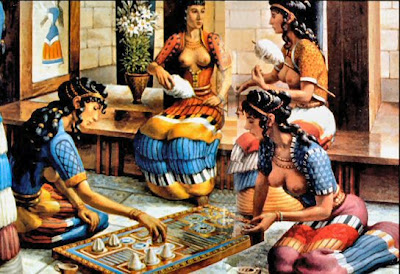
The Minoans seem to have worshipped primarily goddesses, sometimes being described as a "matriarchal religion". Although there is some evidence of male gods, depictions of Minoan goddesses vastly outnumber those of anything that could be considered a Minoan god.
Next Image
Woman Holding Snakes. Crete, c. 1600-1500 B.C. (Late Minoan period, Bronze Age). Ivory and gold, height: 6-3/8 in. (16.1 cm). The holdings of Greek, Roman, and Etruscan art contain many objects of outstanding quality, including the delicate ivory-and-gold female figure entwined with snakes, one of very few sculptures in ivory to survive from the fabled Minoan civilization of Crete.
Peace and love ?
The Minoans share the spirit of peace and love of life in their art. Hutchinson also states in his work Prehistoric Crete that the palaces are characterised by a lack of fortifications and weapons like battle-axes, which are created for artistic and religious purposes, are rarely found there
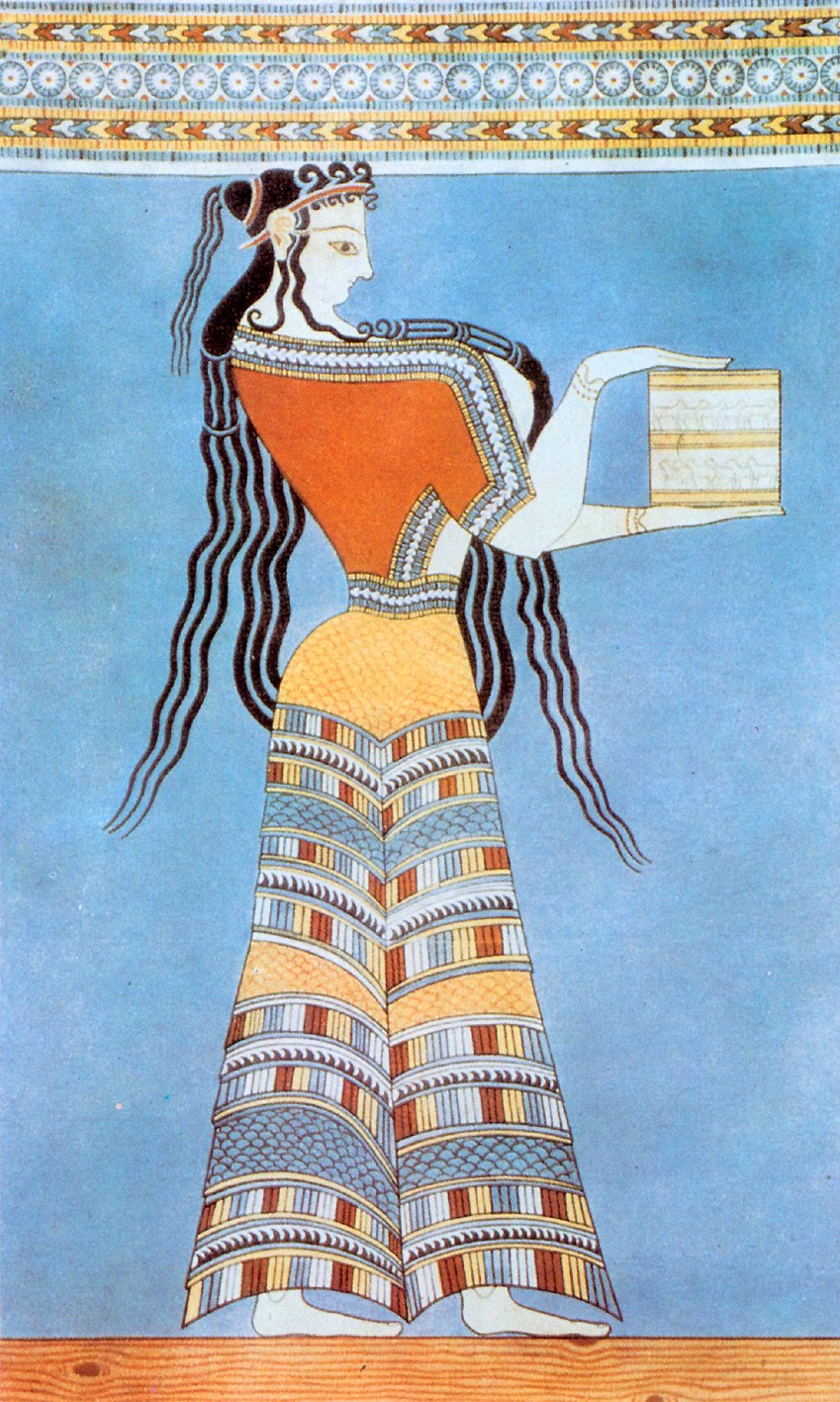
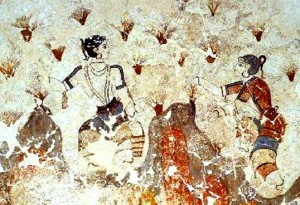
The human figures in Minoan frescoes are often peaceful, joyful, and no scene of war or violence has ever appeared in their art. An example of a fresco with human characters is a piece dated to the Late Minoan period (1550 – 1500 BC), which illustrates a delightful girl dancing in circles with her curly hair flying in the air (Hutchinson, Prehistoric Crete, 277-278). Moreover, the Minoan frescoes are more natural and fluid but less “photographically correct” as compared to the Egyptian wall-paintings of the same period, which seemed too “stiff” and lacked emotions.
In fact, the naturalism was a common theme in most Minoan art works: pottery, seals as well as frescoes. For instance, the Minoan artists loved to draw animals (ex: cat, monkey), plants (ex: rose, lily, myrtle, vetch), rocks (ex: river pebbles)… anything that related to nature (Hutchinson, Prehistoric Crete, 131, 276). The best and finest of the Minoan frescoes, according to Hutchinson, is the one depicting a natural scenery of a Cretan dell, found in Hagia Triada, Mesara: “The scene shows two cats stalking a pheasant and the hindquarters of a roebuck leaping over rocks…” (Hutchinson, Prehistoric Crete, 276-277). In the light of these naturalistic and non-violent frescoes, readers could see how much the Minoans loved life and Nature.
Labrys is a double-headed ax found in ancient Minoan and Hellenic culture and myth. Due to the abundance of labryses in Minoan ruins on the isle of Crete, and labryses featured with women in Minoan images, speculation by scholars linking the ax to Minoan religion and matriarchy has generated a series of women-empowered myths concerning Minoan civilization.
Golden Minoan labrys from Crete, Archaeological Museum in Herakleion. Photo: Wolfgang Sauber (en.wikipedia.org/wiki/File:AMI_-_Goldene_Doppelaxt.jpg, March 2012)
Double-Headed Ax in Minoan Culture
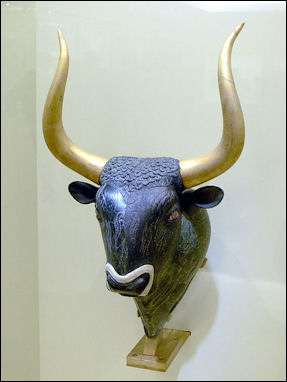
Images of the double-headed ax can be found in different places in the region around the Aegean Sea. Ruins of the Minoan civilization on Crete (2800-1400 BCE) have a large number of such images, some made of gold or bronze and placed upon staffs, others featured on pottery and in paintings. The association of labyrinth (ancient Greek: “place of the labrys”) with Crete and the Minotaur (“Bull of Minos,” a monster kept in the labyrinth) links the labrys with Minoan civilization in Greek myth.
The presence of the double-headed ax among the ruins of a people who had a fondness for bulls, and who often depicted women as important figures in ritual settings, has led some scholars to postulate the ax was for bull sacrifice, and that women held prestigious positions in Minoan society as priestesses and leaders. These assumptions have led to descriptions of Minoan civilization as women-centered, or that Minoan women were on par with men in the public sphere. Minoan civilization took on a mythical aura as a Goddess-centered matriarchy, an assumption that is certainly feasible but by no means conclusive.
Labrys in Lydian Language and Greek Myth
Speculation about Minoan politics and religion notwithstanding, the double-headed ax is associated with Zeus, women warriors, Goddesses, and queens in Greek myth. Zeus has among his titles the name of Zeus Labrayndeus (“Zeus, God of the Labrys”) and has been portrayed carrying a labrys. The Zeus-labrys association is given a strong feminine element in the myth of Metis, Titan of Good Counsel. Zeus feared Metis would bear his future replacement as king of the Gods, and so he swallowed Metis after getting her pregnant. Zeus was then plagued with tremendous headaches because Metis lodged in his head and pounded metal as she made armor for her soon-to-be-born child. Finally, the pain became too much for Zeus. Hephaestus (God of Ironwork) took a labrys, split open Zeus’ skull, and Athena (Goddess of Wisdom and War) jumped out in full armor.
Atheena emerging from the head of Zeus after his head was split with a labrys (westernthoughttheancients.blogspot.com/2009/10/week-2-medea-by-euripides.html, March 2012
Classical Greek myths preserved in Roman times concerning the Amazons, a society of female warriors, mention the double-headed ax in the context of a woman-centered warrior society. The God-man Herakles (Greek: “Glory of Hera,” Hercules to the Romans) is included in myths about Amazons in stories concerning the near-impossible tasks (Twelve Labors of Herakles) that Hera, Queen of Heaven, required of him. One such task was to obtain the girdle of Hippolyte, Queen of the Amazons, who freely gave the girdle to Herakles. A fight broke out between the Amazons and Herakles because of Hera’s secret interference. Herakles killed Hippolyte and took her labrys as well as the girdle. He gave the labrys to Omphale, Queen of the Lydians, to whom he was temporarily enslaved. While serving Omphale, Herakles was forced to dress as a woman and do women’s work, while Omphale wore his lion skin cloak and carried his club, establishing women’s ownership of labrys and (temporarily) Herakles.
Last edited by wvwvw; 05-16-2013 at 07:09 PM.
There are currently 1 users browsing this thread. (0 members and 1 guests)
 Posting Permissions

 Reply With Quote







Bookmarks