

0





| Thumbs Up/Down |
| Received: 3,714/1,597 Given: 1,298/111 |

It was not like God in Semitic religions but it was definitely a deity unlike you pretend. You have many hints for that even in the old inscriptions.Originally Posted by Yaglakar

Just as when Bilge Khagan refers to the role of Sky – Tengri in the inscriptions: ‘All human sons are born to die in time, as determined by Tengri’.
Or from Kul-Tegin monumental complex, when it says: ‘As Tengri (Sky) gave them strength, the army of Khagan my father was like a wolf, and his enemies like sheep’.
Tengri is a deity here.
Tengri is here a countable, one, metaphysical power who interferes in worldly affairs.
Last edited by Böri; 01-22-2018 at 08:40 PM.



| Thumbs Up/Down |
| Received: 646/76 Given: 214/1 |
Tariat inscriptions (Mongolia):
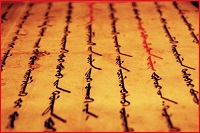
teηride bolmyš el etmiš bilge qaγan el bilge qatun qaγan ataγ qatun ataγ atanyp ötüken kedin učynta tez bašynta örgin…
I heavenly/sky born El Etmish Bilge Qaghan along with heavenly/sky born El Bilge Khatun accepted titles Kaghan and Khatun…
kök teηri jarlyqaduq üčün asra jaγyz jer igit(t)ük üčün elimim törümin etinti…
As the blue sky above condescended and the brown earth below nurtured me, my people and my laws were created…
teηride bolmyš el etmiš bilge qanym ičreki boduny alytmyš…
My heavenly/sky born El Etmish Bilge Qaghan went to subjugate all the tribes….
Later Uighur Buddhist sutra from Qocho:
Yır Täŋri törümishtä bärü bay ymä bar, yog chiğay ymä bar
Since the creation of earth and sky, the rich and the poor exist
Notice how Tengri (sky) and yır/yär (earth) are often used in context, simultaneously both in the steppe runes and urban texts, so according to your argumentation, the brown earth below is also a deity?
In regards to Kultigin translation “‘All human sons are born to die in time, as determined by Tengri’.” and “As Tengri (Sky) gave them strength, the army of Khagan my father was like a wolf, and his enemies like sheep”. They again prove my points I made earlier. Tengri in this context is used as ‘fate determined by sky’, as an ‘object’ from which power, strength is obtained and as an inevitability of events that are to come. Also we need to look at the translation from an academic publication as words might be placed in certain order to indicate something which is absent in the original.
Of course Tengri/sky/heaven is one, when you go outside do you see some kind of a crack or splitting of the sky? You are trying to find meaning where there is none. Mongols after conversion to Buddhism had 1000 Tengries flying in the sky, does it mean there were 1000 Tengries originally?
Descriptions of the Arab traveler about ‘bir tengri’ of the Oghuz Turks are to be evaluated cautiously. Arab/Persian sources about Turkic peoples are of little real academic value. For example Muslim sources dubbed Qocho Uighurs, Karakhanids, and many other differing Turkic tribes from Mongolia as far as Caspian Sea having Toquz Oghuz origin. Similar to terms Saracens and Franks during the Crusades. The absurdity went even further when medieval Muslim sources started calling everyone remotely resembling a man on horseback as ‘Türk’ including Mongols and many other unrelated peoples.
Last edited by Yaglakar; 01-23-2018 at 08:04 AM.
| Thumbs Up/Down |
| Received: 26/63 Given: 0/0 |
Scythians were basically Turkic / Turk.

| Thumbs Up/Down |
| Received: 2,900/98 Given: 2,616/27 |
"Scythians" were broad term for people of various origin under this name.





| Thumbs Up/Down |
| Received: 5,404/770 Given: 6,855/520 |
Join Date: Oct 2012
Total posts: 13
Who are you?
| Thumbs Up/Down |
| Received: 26/63 Given: 0/0 |
I use talpatalk. Why?
| Thumbs Up/Down |
| Received: 3,714/1,597 Given: 1,298/111 |
It doesn't matter, it doesn't need Tengri has the same attributes of Testament's God or Kuran's Allah to be a deity
The evolution through time of the Tengri's attributes, what they became and so don't really matter here.
The thing is Tengri is absolutely a deity.
It's an entity, separate from humans who creates, makes choice, prefers some humans over others, he is countable.
Ibn Fadlan's report on Oghuz Turks (who weren't Muslim yet) about 'Bir Tengre' is important.
Western academics and historiography consider his writings as highly reliable since Fadlan gave objective information about Rus (Vikings with cremation ceremony description), Oghuz, Bulgars and anyone he met.
He talks bad about Oghuz Turks, he explains their habits which he finds weird and explains that bir tengri story.
So, that Fadlan isn't reliable source isn't correct.
| Thumbs Up/Down |
| Received: 646/76 Given: 214/1 |
I conducted a little research and apparently you are taking Fadlan’s remark of ‘bir tengrich’ out of context.
“Nevertheless, when they have agreed on something and have decided to do it, the basest and most wretched of them can come and break the agreement. I have heard them say: ‘There is no god but God; Muhammad is the Messenger of God’ to make a good impression on the Muslims who stay with them, but they do not believe in this firmly. If one of them suffers an injustice, or something bad happens to him, he lifts his head to heaven and says ‘bir tengri’, which means ‘by the one God’ in the language of the Turks, for bir in Turkish means one and tengri is God.” Ibn Fadlan, Ibn Fadlan and the Land of Darkness: Arab Travellers in the Far North (Penguin Classics, 2012), p. 49
“Even more disturbing for Ibn Fadlan is that instead of turning to God, the poor Oghuz chose to lead a life divorced from religion and reason. In his own harsh words, the Oghuz are like al-hamir al-dhalla, that is, strayed asses. Given that they lack a monotheistic din (religion) and are uncaring about ʿaql (reason), it is no wonder that the Oghuz count their chieftains as gods. After Ibn Fadlan fails to convince one of the powerful Oghuz chieftains to convert to Islam, he denies them any positive attributes in religious affairs. Perhaps the result of this failure pushed him to accuse all Oghuz of religious ignorance. Doubting possible future conversions to Islam, Ibn Fadlan warns his readers that the Oghuz care more about filling their own purses than enlightening their souls and minds. Every time an Oghuz man, he tells us, wants to gain money or gifts from Muslim merchants, he pretends to be Muslim by saying bir tengrich, meaning there is only one God.” Nizar F. Hermes, The [European] Other in Medieval Arabic Literature and Culture: Ninth-Twelfth Century AD (Palgrave Macmillan, 2012), p. 84
Tengri cannot be countable because in the eyes of old Turks sky was infinite stretching endlessly in all directions, the way sky visually appears to a clueless steppe onlooker. This is all comparable to early Islamic cosmology where Quran describes the moon following the sun, and the stars falling (meteors, comets in reality) because they are located in ‘nearest’ heaven (closer than both the moon and the sun). As I previously stated, Tengri was used to refer to all kinds of things, the sky/heavens themselves, a supernatural force, in Irk Bitig (9th century) there is reference to ‘yol täƞri’ (Tengri of roads). Various interpretations and meanings related to Tengri started appearing only after the influx of Iranian and Sogdian refugees (Nestorians, Manicheans) into the Eastern Steppes following Arab Muslim onslaught of Transoxiana. There are no common rituals, beliefs, practices or burial rites connected to Tengri. It is not even clear if the old Turks worshipped Tengri/Sky/Heavens.
| Thumbs Up/Down |
| Received: 3,714/1,597 Given: 1,298/111 |
It's countable in the sense it is one. Bilge Khagan refers to one Tengri in the inscriptions on his stele.
It's anyway a deity. The yol Tengri of road? Doesn't matter, the concept refers to the use of the word as deity again, actually that the word becomes synonym for deity.
Tengrism was not an organized religion in the sense of other monotheistic faiths, however Tengrism has one aspect which distinguishes it from Deism or overall Pantheism thats belief of kut (heavenly mandate to rule Kaghan has). Kaghan was khagan, he was recognized by people as khagan because people admitted Tengri gave him kut.
| Thumbs Up/Down |
| Received: 646/76 Given: 214/1 |
Buradaki en inatçı oğuz sen misin? LOL
There are currently 1 users browsing this thread. (0 members and 1 guests)
 Posting Permissions

 Reply With Quote


Bookmarks