

0








| Thumbs Up/Down |
| Received: 23,772/744 Given: 20,612/1,184 |

But you know what ??? That was probably not U106.
Because U106 = R1b1a1a2a1a1 (and not R1b1b1a).
Source: https://isogg.org/tree/ISOGG_HapgrpR.html
So it seems that the authors made a mistake. It was R1b, but not U106.
============
But it depends, because these designations like a1b1b1a... change over time.
Only names of SNPs don't change. Did they actually test them for U106 SNP?




| Thumbs Up/Down |
| Received: 2,347/56 Given: 4,463/0 |
Perhaps, but not quite... this data is newer and has more research behind it:Originally Posted by Peterski

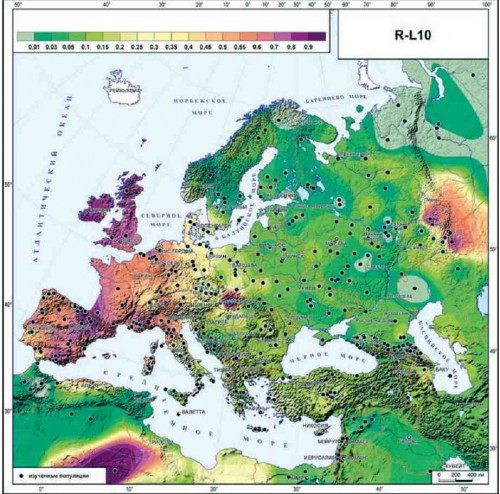
Карта распространения гаплогруппы R1b в целом (R-L10, рис. 2.8.) ярко показывает, что это основной компонент, составляющий более половины Y-хромосомного генофонда Западной Европы. Лишь население южной части Аппенинского полуострова несет сниженные частоты этой гаплогруппы, поскольку у них преобладают средиземноморские гаплогруппы, да еще Скандинавия по географии гаплогрупп относится не к Западной Европе, а формирует самостоятельный северный домен, в котором преобладает иная гаплогруппа — I1.
Гаплогруппа R1b даже в большей степени свойственна Западной Европе, чем R1a свойственна Восточной, поскольку R1b во многих популяциях (Британские острова, баски и ряд других популяций Пиренейского полуострова) составляет даже не половину, а более двух третей генофонда. В целом, тренд гаплогруппы R1b — максимальные частоты у басков и постепенное снижение частоты к востоку от Пиренейского полуострова — очень напоминает географию классического маркера Rh-d (резус-фактор). Всплеск частоты на востоке Европы отражает повышенную частоту R1b у некоторых популяций башкир, известную из работы [Лобов, 2009]. Впрочем, нашим коллективом сейчас завершается подробное исследование разнообразия Y-хромосомы в популяциях башкир (более 1000 образцов). В этом исследовании выявлено, что частота R1b велика только в немногих родовых группах, тогда как для большинства родовых групп башкир характерны другие гаплогруппы, а частоты R1b у них невелики. Поэтому всплеск R1b на востоке Европы отражает не общеевропейскую закономерность, а лишь локальные закономерности происхождения отдельных родовых групп степных популяций Евразии.
"Haplogroup R1b is even more characteristic of Western Europe than R1a is characteristic of Eastern Europe, since R1b in many populations (British Isles, Basques and a number of other populations of the Iberian Peninsula) is not even half, but more than two thirds of the gene pool. In general, the trend of haplogroup R1b - the maximum frequencies in the Basques and the gradual decrease in frequency to the east of the Iberian Peninsula - is very similar to the geography of the classic marker Rh-d (Rh factor). The frequency surge in eastern Europe reflects an increased frequency of R1b in some Bashkir populations, known from [Lobov, 2009]. However, our team is now completing a detailed study of the diversity of the Y-chromosome in Bashkir populations (more than 1000 samples). In this study, it was found that the frequency of R1b is high only in a few generic groups, whereas for most generic Bashkir groups, other haplogroups are characteristic, and the R1b frequencies are low. Therefore, the outburst of R1b in the east of Europe reflects not a common European pattern, but only local regularities of the origin of individual generic groups of steppe populations of Eurasia."
Хотя R1b достигает высоких частот в основном в Западной Европе, карта (рис. 2.8.) показывает, что она (как и R1a) распространена повсеместно, занимая весь картографированный ареал и уходя далеко за его пределы по Евразии. Считается, что R1b имеет переднеазиатское происхождение, и разные ее ветви распространились по различным уголкам Старого Света, но особенно «повезло» лишь той ветви, которая распространилась в Европе и достигла в ней столь значительных частот.
На рисунке показаны только ветви, которые подробно рассматриваются с помощью геногеографических карт; структура схемы соответствует полному дереву гаплогруппы R1b-L10 по версии ISOGG на октябрь 2015 г.
"The figure shows only the branches, which are examined in detail with the help of the genogeographic maps; the structure of the scheme corresponds to the full tree of haplogroup R1b-L10 according to ISOGG version for October 2015."
Source: http://генофонд.рф/?page_id=5629
------------------------------------
Regardless, I am sure there were plenty of assimilations along the way. It is to be expected with the nomadic way of life, and can be seen reflected in all Turkic peoples settled today.
| Thumbs Up/Down |
| Received: 23,772/744 Given: 20,612/1,184 |
What is R1b-L10 ??? It is not the same as R1b-U106.
| Thumbs Up/Down |
| Received: 23,772/744 Given: 20,612/1,184 |
First of all let's remember that we have two branches of R1b-M269 - Eastern and Western. And the most common Bashkir branch is a branch that split even before the emergence of M269:
^^^ R1b-V88 is African (Chadic) branch, but it was also found in prehistoric Iberia:
https://en.wikipedia.org/wiki/Y-DNA_...Saharan_Africa
| Thumbs Up/Down |
| Received: 23,772/744 Given: 20,612/1,184 |
More about R1b-V88 can be found here:
https://www.sciencedirect.com/scienc...02929716304487
https://genomebiology.biomedcentral....059-018-1393-5
IMO it came to Africa from Iberia or Italy.



| Thumbs Up/Down |
| Received: 624/22 Given: 1,146/30 |
Where does the name Bosna or Bosnia come from then?
We all know that Bosnians stayed under the rule and influence of Hungarians for a long time (before Ottomans) and they gave them the name Besenyo (Pecheneg) which in time turned into Bosniya. So Pecheneks=Badjanaks became Bosnyaks eventually. Latins also called them Bissenus
You can check this link as well if you are interested http://s155239215.onlinehome.us/turk...ateline_En.htm






| Thumbs Up/Down |
| Received: 8,202/1,116 Given: 5,685/520 |
Oh please don't be ridiculous.
Bosniaks never existed, it's just religious ethnicity to divide muslim from orthodoxes nothing else.
| Thumbs Up/Down |
| Received: 624/22 Given: 1,146/30 |
You are really confused, I am writing the historical facts, not making up. You even dont need to check out the link, this is written everywhere,
Pecheneg=Besenyo=Bosniya. You can research if you dont believe in me
How do you claim that your ethnicity didnt exist?
| Thumbs Up/Down |
| Received: 8,202/1,116 Given: 5,685/520 |
Bosniaks = Islamized Serbs, Macedonians, Greeks, Italians, Anatolians, Bulgarians,
Muslims who did not move to Turkey stayed in Bosnia, while Orthodoxed expelled them from their original states.
For example Serbia removed all muslims from Serbia and they fled to Bosnia etc...
| Thumbs Up/Down |
| Received: 2,347/56 Given: 4,463/0 |
See U106 in the east here as well

There are currently 1 users browsing this thread. (0 members and 1 guests)
 Posting Permissions

 Reply With Quote

Bookmarks