

0








| Thumbs Up/Down |
| Received: 23,766/744 Given: 20,606/1,184 |

These problems are only with labeling modern populations. But ancient populations were less mixed.Originally Posted by Grace O'Malley

For example ancient inhabitants of the Netherlands were quite different than the modern Dutch:
I4070 with R1b-U106 from North Holland, dated to 1900-1650 BCE, in Eurogenes K15 PCA:
As you can see, modern Dutch average plots between Ancient Dutch I4070 and Ancient Brits:
If I do my own G25 list I will add I4070 as one of Germanic samples (assuming that I4070 is in Global25):






| Thumbs Up/Down |
| Received: 30,167/159 Given: 35,369/35 |
I plot where the Dutch are on that so that doesn't mean anything. There might be ancient Dutch that plot differently. I'm not disagreeing that ancient samples might be more pure or whatever else but they should be called what they are not using a label like Germanic which is a language group. Not all the ancient genomes from Germany are "Germanic". That's my whole point. You can't label pre-Germanic and pre-Celtic genomes as that. The Irish spoke a Celtic language up to the recent past but they are mostly of pre-Celtic genetics i.e. Bell Beaker. It remains to be seen if they actually do have any "Celtic" genomics. We don't know yet.
The Irish Brigade's battle cry at Fontenoy, "Cuimhnigí ar Luimneach agus ar feall na Sasanaigh," translates to "Remember Limerick and the treachery of the English." After seeing the devastation caused by the Irish Brigade, the Duke of Cumberland reportedly remarked, "God curse the laws that made those men our enemies".
| Thumbs Up/Down |
| Received: 23,766/744 Given: 20,606/1,184 |
First / oldest Bell Beakers were probably neither Germanic nor Italic nor Celtic because they were older than these groups emerged.Were Bell Beakers Celtic?
We could as well ask: were "Adam and Eve" Chinese, Germanic, Russian, Melanesian? No, they were too old to be any of those groups.
However, I think that by 900 BC (LBA) there were Celtic languages spoken in Britain. That is just few centuries before Pytheas of Massalia visited Britain:
https://en.wikipedia.org/wiki/Pythea...ery_of_Britain
How do you know this for sure? Linguistics is not exact science and if you ask different linguists, they usually have contradictory theories.No they weren't
I4070 is not "pre-Germanic", he has typically Germanic Y-DNA, clusters autosomally with Scandinavians, and spoke a Germanic language - or Proto-Germanic or "old Germanic", you name it. But it is generally agreed that North Holland was among the oldest areas of Germanic settlement. Unlike Britain.You can't label pre-Germanic and pre-Celtic genomes as that.
Celts evolved from Bell Beakers - Bell Beakers were ancestral to Celts.but they are mostly of pre-Celtic genetics i.e. Bell Beaker
On the other hand, Germanic people also received Corded Ware input.


| Thumbs Up/Down |
| Received: 17,554/196 Given: 8,307/117 |
Call it Nordic, including it as Germanic would be simply incorrect.
Like Grace said, I don’t understand the compulsion to equate everything with linguistic groups. That is the issue that people have with Celtic vs Germanic, not that they can’t be separated, but that nobody seems to agree what defines them.
e.g., most of my Ancestors 2000 years ago were Celtic, but a minority of my ancestors were Celts, and I’m not Celtic at all (well very little).
Spoiler!
| Thumbs Up/Down |
| Received: 30,167/159 Given: 35,369/35 |
You know enough about genetics to know the answer. Even if populations spoke Celtic what does it mean genetically? That's what I've asked you previously about what does Celtic mean genetically? We have Hallstatt Celts but Irish and Scots don't cluster with them.
The Irish Brigade's battle cry at Fontenoy, "Cuimhnigí ar Luimneach agus ar feall na Sasanaigh," translates to "Remember Limerick and the treachery of the English." After seeing the devastation caused by the Irish Brigade, the Duke of Cumberland reportedly remarked, "God curse the laws that made those men our enemies".
| Thumbs Up/Down |
| Received: 23,766/744 Given: 20,606/1,184 |
I'm of the opinion that Germanic ethnogenesis was in the Nordic Bronze Age culture, so for me Nordic and Germanic is the same.
| Thumbs Up/Down |
| Received: 23,766/744 Given: 20,606/1,184 |
At some point in time there was a population of Proto-Celts and that population later migrated in various directions, giving rise to different Celtic populations.
They were from Hallstatt Bylany - which was but one sub-branch of the Hallstat culture, probably mixed with local people similar to Bronze Age Hungarians.We have Hallstatt Celts but Irish and Scots don't cluster with them.
Also those were Late Hallstatt samples, we don't heavy Early Hallstatt yet. And it is also unlikely that the Celtic ethnogenesis took place in Hallstatt culture.
Just like it is unlikely that Proto-Indo-Europeans were the Yamnaya. Yamnaya was only one sub-branch of Indo-Europeans, descended from something else.
Sredny Stog II for example was also an Indo-European culture.
DA111 and DA112 - the two Hallstatt Bylany samples - don't even cluster with each other. They have quite different results.don't cluster with them.
And DA111 is genetically intermediate between modern Irish and modern French. So it could be partially ancestral to both groups.
| Thumbs Up/Down |
| Received: 23,766/744 Given: 20,606/1,184 |
I don't believe that Hallstatt were Proto-Celts just like I don't believe that Yamnaya were Proto-Indo-Europeans.
Hallstatt was one of early Celtic cultures, but not the oldest one and not Proto-Celtic (not ancestral to old Celts).
Yamnaya was also one of early subdivisions of Indo-Europeans, but not THE oldest culture ancestral to all IE groups.
Some branches of Indo-Europeans - such as Proto-Anatolians - split from the rest before the emergence of Yamna.
And Satem languages are descended from Sredny Stog (culture older than Yamnaya) which gave rise to Corded Ware.
| Thumbs Up/Down |
| Received: 30,167/159 Given: 35,369/35 |
Obviously then there needs to be more samples but people like the Irish are similar to other Northwestern Europeans so either the Celts are like the Irish or Irish are not just Celtic. Either way labelling ancient genomes by later language groupings is problematic.
The Irish Brigade's battle cry at Fontenoy, "Cuimhnigí ar Luimneach agus ar feall na Sasanaigh," translates to "Remember Limerick and the treachery of the English." After seeing the devastation caused by the Irish Brigade, the Duke of Cumberland reportedly remarked, "God curse the laws that made those men our enemies".
| Thumbs Up/Down |
| Received: 23,766/744 Given: 20,606/1,184 |
Northern French are similar to the Irish too.
And wait for the study called "Genetic history of France", which will show that before the Roman conquest also Central France was like modern Northern France.
Recent study about the genetic history of Iberia showed, that modern Iberians are heavily mixed with Italians who migrated there during Roman rules.
The same conclusion will be reached about France, except Northern France which remained untouched by Roman/Italian settlers.
BTW, I suppose that there was also a migration of Iberians (maybe already Romanized Iberians) to Southern/Central France during Roman times.
There are currently 13 users browsing this thread. (0 members and 13 guests)
 Posting Permissions


 Reply With Quote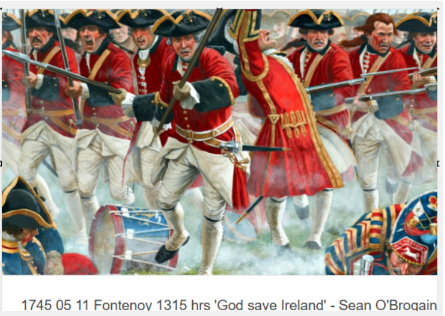
Bookmarks