

0




| Thumbs Up/Down |
| Received: 3,746/73 Given: 5,142/86 |

We've already accepted that Modern Iranians aren't that close to Proto-Iranics you imbecile. Its you that has issues accepting the fact that they didn't descend from todays North Europeans populations, but rather a population that was North-european like.Originally Posted by Token

| Thumbs Up/Down |
| Received: 3,746/73 Given: 5,142/86 |
Close. They didn't force them into Iran, but they wiped out 60% of the population. Later, Turkics came in, mixed with the locals and assimilated the rest of the remaining population.

| Thumbs Up/Down |
| Received: 7,949/223 Given: 57,097/504 |
So they were like brunns and borrebies?




| Thumbs Up/Down |
| Received: 646/76 Given: 214/1 |
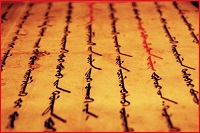
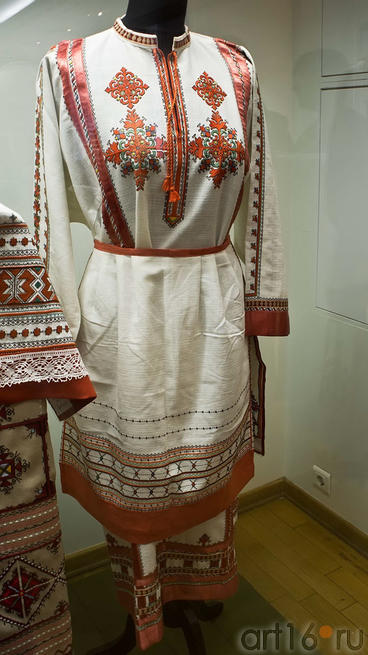
How did you establish that this indeed is Andronovo attire? Is it dressmakers imagination or a model based on concrete physical evidence aka excavations? I see that the garment's geolocation is in some place in Almaty. I witnessed an interesting case recently. In some Kazakh museum, there was this belt but the buckle was quite old, and on it were some letters which resembled Old Turkic and in the museum description tag it was written Old Turkic inscriptions. The photo was posted in another forum, it turns out the letters are actually eastern Arabic numerals, 1898 or something.
You also cannot post modern "folk" clothing which is often inspirational or made to fit certain recent discoveries. If this is actually Andronovo model attire, you have to post old photos of Chuvashes, to be certain of the fact that Chuvashes wore similar kind of clothing a hundred years back.
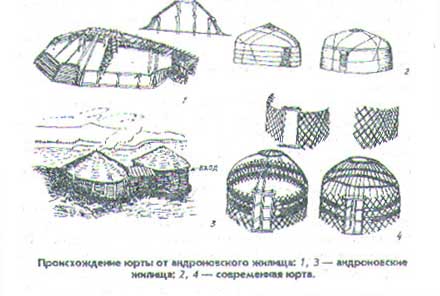
Records do not indicate that proto-Turks or even old Turks lived in yurts (as in foldable mobile houses). But records do indicate, that yurts (their descriptions) are becoming common with Mongolic activity in the region. Yurts evolved from Mongolic gers. Prior to that Turkics lived in tents like their Iranic predecessors.
| Thumbs Up/Down |
| Received: 646/76 Given: 214/1 |
Iranic nomads were absorbed long before that. There might have been few remaining ones prior to immediate Mongol expansion. The ones that were in southern Kazahstan, Uzbekistan and Kyrgyzstan were settled ones, mostly eastern Iranics but probably by that time already mixed with Persians. According to records large areas of Uzbekistan, southern Kazakhstan and Kyrgyzstan were bilingual (that's 11th century). Mongols facilitated Turkicization.

| Thumbs Up/Down |
| Received: 514/87 Given: 315/40 |
You are talking about yourself.
watch from 2:40
| Thumbs Up/Down |
| Received: 514/87 Given: 315/40 |
Neolithic_Iranian Plateau auDNA in both groups.




| Thumbs Up/Down |
| Received: 11,115/213 Given: 10,109/550 |
""-Most notably, the huge, 2015 study, by Peter A. Underhill et al., using 16,244 individuals from over 126 populations from across Eurasia, concluded that there was "compelling evidence that the initial episodes of haplogroup R1a diversification likely occurred in the vicinity of present-day Iran." "
"The study also concluded that R1a is present in South Asia ACROSS linguistic groups including Indo European, Dravidian and tribal groups. Given the close connections between Indo-Iranian texts it is clear that ancient South and West Asia were as multilingual as they are today. Iranian Avestha itself traces its roots back to South Asia and the Sindhu (Indus) Sarasvati civilization. "
Lmaooooo

| Thumbs Up/Down |
| Received: 265/17 Given: 11/0 |
Tent?How could it be heated in winter ? What is the records? Yurt is from mongolic ger- what is promongolic fantasy? Mongolic etimology of yurt?


| Thumbs Up/Down |
| Received: 6,154/1,071 Given: 10,212/98 |
This thread turned into a big shitfest.
First of all, most Iranians don't have a considerable amount of "Aryan" genetic contribution, I myself only have 12%, we are predominantly natives with a small steppe admix that were culturally and linguistically assimilated. Kurds and Persians don't have much in resemblance compared to the Proto-Iranian Andronovo culture, the attire, dialect and culture differs albeit having some similarities here and there.
But Proto-Iranians weren't "Northern European", they were more Eastern European because of their high EHG admix, Andronovo itself plots in Eastern Europe. Mesolithic Iranians btw already had some EHG while the more Southern neolithic groups had almost none.
Andronovo is slightly north of Poland in Eurogenes K15:

There are currently 2 users browsing this thread. (0 members and 2 guests)
 Posting Permissions

 Reply With Quote

Bookmarks