

2








| Thumbs Up/Down |
| Received: 17,266/194 Given: 8,168/117 |

One of the researchers says categorically in this podcast that the France IA ancestry was not present in the Roman or Iron Age periods, but was a significant feature of the early medieval period. Very surprising and quite amazing if true, core English history would be re-written (but actually based on truth for once).Originally Posted by Creoda

https://media.immediate.co.uk/volati...4d1bc2.mp3?_=1
I guess these people spoke Frankish rather than Gallo-Romance? Might have been hard to integrate so much with Anglo-Saxons if they weren't culturally Germanic.
Last edited by J. Ketch; 06-30-2022 at 01:08 AM.
Spoiler!


| Thumbs Up/Down |
| Received: 7,371/127 Given: 2,702/43 |
Do they say if the French stuff was mainly found in conjunction with WBI or CNE ancestry?
| Thumbs Up/Down |
| Received: 17,266/194 Given: 8,168/117 |
Don't recall him mentioning it but I don't think the study has any sites without CNE ancestry, going by the slide posted on the last page the Southern English sites all look like 3-way mixes.
Spoiler!


| Thumbs Up/Down |
| Received: 7,328/30 Given: 2,684/16 |
I doubt christianized Franks emigrated to pagan Anglosaxons kingdoms, their supposed Germanic common heritage was minor thing compared to this difference, sorry bro... Not in early medieval times, no way.
Christianization of the Franks was the process of converting the pagan Franks to Catholicism during the late 5th century and early 6th century.The Christianisation of Anglo-Saxon England was a process spanning the 7th century.


| Thumbs Up/Down |
| Received: 8,393/56 Given: 8,659/5 |
I think I can explain.
The place name research by Udolph (1994) strongly suggests that the Germanic migration to Britain was notably simpler than what is commonly taught. Saxons had migrated to England but mainly from the adjacent side of the English Channel. At that time (at abt. 450 AD) they had already lived there for centuries all the way from the Rhine mouth to Aremorica (the mainland part of the so called Litus saxonicus). Also, Flandres is shown as a main source of Germanic migration to England. It's a confusion to suppose Lower Saxony to be the direct source of Saxons migrating to England, though there likely was some migration as well.
Germanic Angles were distributed here and there in Germania, just f. i. they made up an important part of the new emerged Thuringian tribe. It's just Bede's good guess that they came from that small reggion called Anglia in Schleswig-Holstein. He had simply no clue and all people today just follow his (expressly) guess whithout own considerations. His guess might be true, but the Angles in question could as well have been in the Rhine mouth proximity.
Finally the Jutes. This is for sure a misstake to assume any notable migration from Jutland to England. There is absolutely no place name indication for that and also, the Germanic settlers in the areas that were settled by "Jutes", Kent and the Isle of Wight, do show the Germanic settlers with the biggest (!) influence by Romans in their material culture. Out of the three mentioned tribes Juteland-Jutes would, in contrast, be these Germanics with the least contact to Romans. But there was a small Germanic tribe called Eotas that had lived at the Rhine mouth. Maybe these Eotas once, centuries ago, had some connection to Jutland-Jutes, but this would be pure speculation based on the name. Also, it's close to absurd to think that the big Jutland peninsula should have got "emptied" by Jutes migrating to the "micro" territories of Kent and the Isle of Whight. So we can actually better ignore all these big arrows on history maps that fantasizes about the migrations of Jutes from Jutland, Angles from that small Anglia region and Saxons from Lower Saxony to the British Isles.
The mentioned by me Germanics simply crossed the English channel and the connection was the strongest where there was the shortest distance. Still in the 9th century the Pas de Calais was Flemish settled (the inhabitants later became Frenchicised) so you had something like a pretty direct Germanic language contact. Between Kalen (Calais) and Dover you have just 32 kilometers of water. Of course these Germanics that had lived in Northern France for centuries as Germanics had picked up some "France_IA" DNA.
Now, this huge migration coincides with the Frankish advance to the sea. So obviously all that today tribal Lower Franks in Netherlands and Flandres were no Franks or not yet there at that time. So these areas will have been inhabited by Saxons, Eotas and maybe even Angles. Remaining folks were tribally Frankicised and Franks did immigrate to there. Maybe the Saxons were fleeing the Franks, maybe Franks were pulled to advance in that direction after many Saxons had left and maybe it was all together a combination of various push and pull factors, on the mainland and on the British Isles.
Last edited by rothaer; 07-01-2022 at 01:35 AM.
Target: rothaer_scaled
Distance: 1.0091% / 0.01009085
39.8 (Balto-)Slavic
39.0 Germanic
19.2 Celtic-like
1.8 Graeco-Roman
0.2 Finnic-like
In the models posted by Creoda the main difference between the English and their neighbours is the higher Neolithic percentage. If that makes you Germanic then so be it (not that I question their Germanic origin, but the Roman and whatever other Atlantic-med type admixture is ignored on purpose for obvious reasons).
| Thumbs Up/Down |
| Received: 8,393/56 Given: 8,659/5 |
Just as an example here is a distribution map for the place name stem "wik". Hundreds of place name stems have been examined and mapped by Udolph. This one obviously concerns England.

Target: rothaer_scaled
Distance: 1.0091% / 0.01009085
39.8 (Balto-)Slavic
39.0 Germanic
19.2 Celtic-like
1.8 Graeco-Roman
0.2 Finnic-like


| Thumbs Up/Down |
| Received: 2,503/11 Given: 1,543/0 |
I always gave greater value to this theory, Southern England seems to lean too near to Flanders for one to think that whole place was Jute for a great chunk of its history, those Kentish Jutes had a artistry and material culture, that I found much too foreign and elaborate for them to have picked up from a somewhat romanised populace that took them too little time to overwhelm and replace. I don't disregard that they spawned from Jutes in the same way continental Goths could've spawned from Gears or Gutes, to a nearer extent, but it's more plausible to me that they were in the continent mingling about with others before heading west. As far as Angeln is concerned that's a tiny chunk in today's Slesvig-Holsten that I can't realistically see as the spawn of what would make at least 4 kingdoms out of the Anglo-Saxon heptarchy, it's quite the feat if true.
______________
| Thumbs Up/Down |
| Received: 17,266/194 Given: 8,168/117 |
1 - The Christianisation of the Franks began in the late 5th century, while the Anglo-Saxon invasions of Britain began c.450 (from which the bulk of early English would be descended), so there is ample time for pagan Franks to travel with and to pagan Saxons
2 - This France IA admixture may have come later into the Christianised kingdoms, it hasn't been specified yet
3 - Either way the admixture is there and it's France IA, not Germanic Frankish as such. The Roman Gauls were more Christianised and earlier than the Franks, so does them moving to pagan England make any more sense?
4 - There is supposedly a wealth of Frankish archaeological finds and artefacts across early medieval England, so they are obviously connected, but that will be elaborated on soon by John Hines (relevant slide posted last page)
Which models? By neighbours I assume you mean only Welsh, Scottish and Irish, because North French, Belgians and South Dutch have more Neolithic Farmer than England. The emerging academic models are showing a large difference in Germanic admixture between English and Insular Celts, but also much higher Gaulish Celtic admixture. That's not being ignored, it's key to the reason why England plots where it does, between Wales/Scotland and the Southern Netherlands, and not Denmark. On the contrary it is usually people trying to minimise the nation's Germanic ancestry and heritage; declaring the Anglo-Saxon migration/admixture to be smaller than it was has been fashionable for a long time (I never believed that), as well as the incorrect idea that the English are mostly Celtic Briton.
Last edited by J. Ketch; 07-01-2022 at 02:24 AM.
Spoiler!



| Thumbs Up/Down |
| Received: 30,090/159 Given: 35,261/35 |
What is absolutely fascinating about this IA_France is when it spread? Could it be Norman related? The Normans weren't just from Normandy but Flemish and Bretons also. Is this mixture something more Southern?
Just getting impatient for the paper to be published.
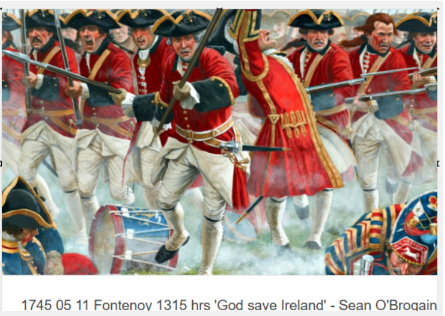
The Irish Brigade's battle cry at Fontenoy, "Cuimhnigí ar Luimneach agus ar feall na Sasanaigh," translates to "Remember Limerick and the treachery of the English." After seeing the devastation caused by the Irish Brigade, the Duke of Cumberland reportedly remarked, "God curse the laws that made those men our enemies".
There are currently 1 users browsing this thread. (0 members and 1 guests)
 Posting Permissions

 Reply With Quote
Bookmarks