

4











| Thumbs Up/Down |
| Received: 39,247/122 Given: 18,856/0 |


| Thumbs Up/Down |
| Received: 8,909/29 Given: 5,292/29 |
My father received it for the Middle Ages, he is in the same group with one from Portugal and 3 unknown people, then there is the red flag with the green star. I don't intend to publish it, I totally renounce it, I totally reject it, never!
https://www.yfull.com/tree/E-BY7449/
E-V22 - E-BY7449 - E-BY7566 - E-FT155550
According to oral family tradition E-FT155550 comes from a deserter of Napoleon's troops (1808-1813) who stayed in Spain and changed his surname.







| Thumbs Up/Down |
| Received: 1,615/11 Given: 9,873/235 |
Well, now you peaked my curiosity. Just because someone in Morocco shares it is no reason to renounce it. You may as well renounce your father.Originally Posted by Gallop



| Thumbs Up/Down |
| Received: 4,310/87 Given: 5,625/0 |
Mine updated to K1a12a4. There is one other person who shares this with me however they do not have their country of origin listed.
mtree on yfull gave me k1a12a4a, which it shows that i share it with 2 israeli druze.




| Thumbs Up/Down |
| Received: 3,125/36 Given: 1,428/228 |
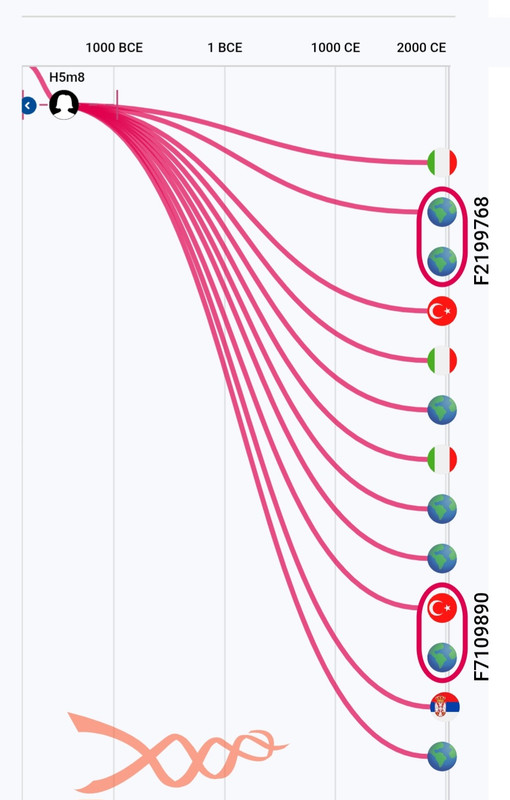
My tree



| Thumbs Up/Down |
| Received: 19,405/12 Given: 24,982/5 |
So... I'm U5a! Any info about it?



| Thumbs Up/Down |
| Received: 34,029/131 Given: 29,092/5 |
"Amicus Plato, sed magis amica veritas"
"Dimidium facti, qui coepit, habet: sapere aude, incipe."





| Thumbs Up/Down |
| Received: 9,495/27 Given: 8,100/2 |
I really should save up for FTdna, especially considering my rare mt haplo.
"3:16 For YHWH so loved the world, that He gave His only begotten Son, that whosoever believeth in Him should not perish, but have everlasting life.."
#GodWins

| Thumbs Up/Down |
| Received: 2,848/3 Given: 4,247/14 |
my maternal haplogroup is according to DNAGenics: H1ao
Your haplogroup H1ao emerged approximately 7900 years ago
Your root haplogroup H emerged approximately 12000 years ago in Western Eurasia, particularly in Europe and the Near East
7900
Users share your haplogroup assignment: 1 in 548
About Haplogroup H1ao
Detailed information about your maternal lineage
Haplogroup H1 is one of the most prominent subclades of mitochondrial DNA (mtDNA) haplogroup H, which itself is the most common maternal lineage in Europe. Haplogroup H1 is particularly significant in the genetic history of European populations, as well as some populations in North Africa and the Near East. H1 is maternally inherited and plays an essential role in understanding the migration, adaptation, and genetic diversity of early human populations in Europe following the Last Glacial Maximum (LGM).
Origin and Evolution
Haplogroup H1 is estimated to have originated approximately 13,000 to 15,000 years ago, most likely in the Iberian Peninsula or southern France. It is a descendant of haplogroup H, which emerged during or after the Last Glacial Maximum, around 20,000 to 25,000 years ago. The origin of H1 is closely tied to the post-glacial recolonization of Europe when populations that had retreated to glacial refugia in southern Europe began migrating northward as the climate warmed and the ice sheets retreated.
During the LGM, large portions of Europe were uninhabitable due to the extensive ice cover. Populations in Europe were forced to take refuge in warmer areas, particularly in southern regions such as Iberia, Italy, and the Balkans. Haplogroup H1 likely expanded from these refugia as humans migrated back into Central and Northern Europe during the Holocene, around 10,000 years ago.
Subclades and Geographic Distribution
Haplogroup H1 is one of the largest and most widespread subclades of haplogroup H, with numerous branches and subclades found in different parts of Europe, North Africa, and the Near East. Some of the significant subclades of H1 include:
H1a: This subclade is distributed across Europe, particularly in Western and Central Europe, but is also found in North Africa and the Near East. Its distribution reflects the migrations and expansions of populations during the post-glacial period.
H1b: Found primarily in Eastern and Central Europe, H1b is also present in Scandinavia and some parts of Western Europe. This subclade may be associated with the expansion of early farming communities during the Neolithic period.
H1c: Found mainly in Central and Eastern Europe, H1c provides evidence for the migration patterns of populations in these regions during prehistoric times.
H1f: This subclade is found at low frequencies in Europe and may reflect more localized population movements within the continent.
Geographic Distribution and Significance
Europe
Haplogroup H1 is widespread across Europe, with the highest frequencies found in the Iberian Peninsula, particularly in Spain and Portugal. It is also prevalent in France, Italy, and parts of the British Isles, including Ireland. The presence of H1 in these regions reflects its origin in Iberia and southern France, where populations carrying H1 likely expanded after the Last Glacial Maximum.
H1 is also found in significant frequencies in Central and Eastern Europe, where it contributed to the recolonization of these regions as populations moved northward from southern Europe. Its presence in Scandinavia, including Norway, Sweden, and Denmark, reflects the later migrations of populations into northern Europe.
In addition, H1 is particularly common in the Basque population of northern Spain and southwestern France, where it is found at some of the highest frequencies in Europe. The Basques are thought to have preserved a relatively ancient genetic makeup due to their relative isolation from other European populations, and the high frequency of haplogroup H1 among the Basques suggests that they are one of the modern groups most closely related to the original populations that expanded from Iberia after the Ice Age.
North Africa
Haplogroup H1 is also found in relatively high frequencies in North Africa, particularly among Berber populations in Morocco, Algeria, and Tunisia. This distribution likely reflects ancient migrations from Europe to North Africa during the post-glacial period and subsequent gene flow between these regions.
The shared genetic heritage between European and North African populations suggests that human populations have been moving and interacting across the Mediterranean for thousands of years. The high frequency of H1 among Berbers highlights the historical genetic connections between southern Europe and North Africa.
Near East
In the Near East, haplogroup H1 is present at lower frequencies compared to Europe, but its presence is significant in populations such as the Druze in Lebanon and Israel. The distribution of H1 in the Near East likely reflects ancient population movements and trade routes connecting Europe with the Near East during prehistoric times and later historical periods.
Central Asia
Though much less common, haplogroup H1 has also been detected in some populations of Central Asia. This likely reflects ancient migration routes from Europe into Asia, including during the Bronze Age and later periods of nomadic expansion.
Population Genetics and Historical Insights
Haplogroup H1 has been extensively studied in the context of European population genetics, particularly regarding the post-glacial recolonization of Europe. Its distribution provides critical evidence for the migration routes taken by early humans as they moved out of glacial refugia and resettled the continent.
Haplogroup H1 is also a key marker in studies of ancient DNA, where it has been found in prehistoric human remains across Europe, including Mesolithic hunter-gatherers and Neolithic farming communities. These findings show that H1 was present in Europe before the arrival of agriculture and continued to be a dominant maternal lineage during the transition to farming.
The widespread presence of haplogroup H1 across Europe and North Africa reflects the long history of human migration and interaction between these regions. Genetic studies have used H1 to trace the movements of populations across the Mediterranean and into Europe during different periods, including the Ice Age, the Neolithic expansion of farming, and later historical migrations.
Ancient DNA Studies
Haplogroup H1 has been identified in several ancient DNA studies, providing direct evidence of its presence in prehistoric populations. For example, H1 has been found in Mesolithic hunter-gatherer remains from Iberia and France, showing that it was present in Europe before the arrival of agriculture. It has also been detected in Neolithic remains from farming communities, highlighting its role in the genetic makeup of early European farmers.
Ancient DNA studies have also shown that haplogroup H1 was present in the Bell Beaker culture, which spread across Western and Central Europe during the Bronze Age. The presence of H1 in ancient DNA samples supports the theory that populations carrying this lineage played a significant role in shaping the genetic landscape of Europe during the post-glacial and Neolithic periods.
Genetic Diversity and Evolutionary Significance
Haplogroup H1 is one of the most genetically diverse subclades of haplogroup H, with numerous subclades and branches that reflect the complex migration history of Europe. This diversity suggests that H1 underwent significant expansion during the post-glacial period, as populations spread across the continent and adapted to different environments.
The evolutionary significance of haplogroup H1 lies in its role in the recolonization of Europe after the Last Glacial Maximum. As populations carrying H1 expanded from southern refugia into northern and central Europe, they likely encountered and interbred with other groups, contributing to the genetic diversity of modern European populations.
Conclusion
Haplogroup H1 is one of the most important and widespread mtDNA subclades in Europe, with a deep history that traces back to the post-glacial recolonization of the continent. Originating around 13,000 to 15,000 years ago, likely in the Iberian Peninsula, H1 expanded across Europe as populations migrated northward following the retreat of the glaciers.
Today, haplogroup H1 is found at high frequencies in Western Europe, particularly in the Basque population, as well as in Central and Eastern Europe, North Africa, and parts of the Near East. Its presence in these regions reflects the long history of human migration and interaction across Europe and the Mediterranean.
Haplogroup H1 continues to be a key focus in population genetics and ancient DNA studies, helping to unravel the complex patterns of human migration and adaptation that have shaped modern populations across Europe, North Africa, and beyond.
Population Distribution
European populations (especially in Western Europe, including the Iberian Peninsula, France, and the British Isles)
North African populations (especially in the Berber populations)
Some populations in the Middle East
Some populations in Central Europe and Scandinavia
Jewish populations, particularly Ashkenazi Jews
| Thumbs Up/Down |
| Received: 9,495/27 Given: 8,100/2 |
Interesting that U5b is far more common in Iberians...perhaps it really is from a Visigoth (or other non-Iberian) distantly? Not sure how many females members traveled with their men in these adventures.
"3:16 For YHWH so loved the world, that He gave His only begotten Son, that whosoever believeth in Him should not perish, but have everlasting life.."
#GodWins
There are currently 1 users browsing this thread. (0 members and 1 guests)
 Posting Permissions


 Reply With Quote


Bookmarks