

0







| Thumbs Up/Down |
| Received: 2,310/142 Given: 339/68 |

Originally Posted by Rumata

Well it was happened in the middle ages, it is a completely different history.




| Thumbs Up/Down |
| Received: 861/33 Given: 517/0 |
G2a/J2 civillization builders
R1a/R1b civillization stealers/occupyers


| Thumbs Up/Down |
| Received: 2,867/45 Given: 2,767/89 |
cope


| Thumbs Up/Down |
| Received: 4,332/87 Given: 5,638/0 |
My man.
| Thumbs Up/Down |
| Received: 2,310/142 Given: 339/68 |
TWO MAJOR Y-DNA HAPLOGROUPS THAT SHAPED EURASIA: R1a vs J2 (THE STEPPE HIGHWAY vs THE CITY-AND-SEA WORLD)
Zane History Buff — these are paternal lineages (father → son). Not “races,” not “tribes,” not “nationalities.” Just deep male-line branches that rode huge population expansions across thousands of years.
If Eurasia is a giant historical chessboard, R1a and J2 are two of the most important “paternal signatures” stamped across it. They don’t tell you your full ancestry—but they do tell you about one very specific thread: your direct fatherline, one father per generation, stretching back into prehistory.
⸻
1) R1a — THE STEPPE HIGHWAY LINE
🐎 The core story
R1a is often associated with the great Bronze Age movement corridors across Eastern Europe, Central Asia, and into South Asia. Its most famous “big expansion moment” is linked to populations carrying substantial steppe ancestry during the 3rd–2nd millennia BCE, when mobile pastoralist societies and their descendants spread widely.
⏳ Timeline (big picture)
• Before ~3000 BCE: Europe and western Eurasia are dominated by a mix of early farmers and older hunter-gatherer lineages.
• ~3000–2000 BCE (Bronze Age): steppe-linked expansions transform genetic, cultural, and linguistic landscapes across large parts of Eurasia.
• Iron Age → Medieval: later population growth, elite formation, migrations, and state-building amplify some male lines further.
🧭 Why it spread so widely (mechanisms)
R1a’s large footprint fits a pattern seen in many expansions:
• high mobility (horse/wagon culture, seasonal movement, long-distance networks)
• open terrain advantages (forest-steppe, plains, river corridors)
• founder effects (some male lines multiply fast if they sit in the right social structure)
• warrior + patronage dynamics (not “one conquest,” but repeated waves where some male lines become over-represented)
🧬 Key sub-branches people talk about (useful, but keep it broad)
• R1a-M417 is a major trunk branch often discussed in Bronze Age expansions.
• A large downstream split often used in popular summaries:
• R1a-Z282: more common across Eastern/Central Europe (often strong in many Slavic-speaking regions, but not exclusive to them).
• R1a-Z93: more common across parts of Central/South Asia (again: not exclusive, but prominent).
Zane rule: haplogroups don’t equal languages. But expansions can overlap with language spread because people move with families, not just words.
🗺️ Where it shows up today (broadly)
• Strong presence in parts of Poland, Ukraine, Belarus, Russia, and wider Central/Eastern Europe.
• Significant presence across parts of Central Asia and South Asia in different sub-branches.
⸻
2) J2 — THE CITY-AND-SEA LINE
🌾🏛️ The core story
J2 is often associated with the long arc from the Fertile Crescent / Near East into the Mediterranean world—a lineage frequently found in regions tied to early agricultural intensification, cities, trade networks, and empires.
If R1a is the “horse-road” signature, J2 is the “market-road” signature.
⏳ Timeline (big picture)
• Neolithic era (starting ~9000–6000 BCE in the Near East): agriculture and settled life expand outward in multiple waves.
• Bronze Age city systems (~3000–1200 BCE): trade routes and imperial hubs intensify movement across Anatolia, the Aegean, the Levant, Mesopotamia, and beyond.
• Classical → Roman → Medieval: ports, armies, administrators, and merchants move constantly, spreading lineages through urban centers and coastlines.
🚢 Why it spread (mechanisms)
J2’s footprint is consistent with:
• dense settlement zones (river valleys, fertile plains)
• urbanization (cities draw people in; cities generate “genetic gravity”)
• trade corridors (ports and caravan routes connect distant regions)
• state systems (armies, administrators, and colonists move under imperial structures)
🧬 Important sub-branches (broad)
• J2a often discussed in contexts tied to Anatolia/Caucasus/parts of the Mediterranean
• J2b often discussed across parts of the Balkans/Italy/Mediterranean corridors
(These are simplifications, but helpful for audience-friendly storytelling.)
🗺️ Where it shows up today (broadly)
• Common across parts of Italy, Greece/Aegean, Anatolia/Turkey, the Levant, the Caucasus, and pockets around the Mediterranean and Near East.
⸻
3) R1a vs J2 — SAME GAME, DIFFERENT ENGINES
✅ Similarities (why both became “major”)
Both became widespread because they were amplified by the same deep rules of population history:
• expansion + reproduction, not “one event”
• founder effects: some male lines multiply faster than others
• network advantage: being on a corridor (steppe highway or trade highway) changes everything
• layering: Bronze Age and Neolithic foundations later get reshaped by empires, migrations, plagues, and state formation
🔥 Differences (their “map logic”)
R1a = often strongest where land-mobility corridors dominate
• steppe/forest-steppe/plains and big river routes
• expansion patterns consistent with Bronze Age steppe-linked demographic shifts
J2 = often strongest where urban + trade ecosystems dominate
• fertile basins, coastal routes, city networks
• expansion patterns consistent with Neolithic-to-Bronze Age “civilization corridors” and later Mediterranean/imperial movement
⸻
4) COMMON MISUNDERSTANDINGS (THE STUFF DNA TESTS DON’T EXPLAIN WELL)
❌ “R1a = one ethnicity”
No. R1a exists across many cultures and languages. A haplogroup is older than modern identities by thousands of years.
❌ “J2 = Greeks / Phoenicians / Romans”
J2 is broader than any one ancient people. Ancient Mediterranean civilizations were genetically mixed and constantly moving.
❌ “My haplogroup tells me my full ancestry”
No. Your Y-DNA haplogroup is one line. You have:
• 2 parents
• 4 grandparents
• 8 great-grandparents
• 16…32…64…
Within 10 generations you have over 1,000 ancestors. Your Y-line is just one of them.
So haplogroups are best used as history lenses, not identity cages.
⸻
5) ZANE HISTORY BUFF MINI-STORY VERSION
Imagine two brothers separated by geography in deep time:
• One follows the grasslands, learns the rhythm of horses, wagons, seasonal movement, and long distance corridors. His descendants spread across the plains and forests. That’s R1a energy.
• The other follows the fertile valleys, the ports, the marketplaces, the city-states, the empire roads, the merchant routes. His descendants spread where civilization concentrates people. That’s J2 energy.
Two lineages. Two engines. One Eurasian story.
⸻
ZANE HISTORY BUFF TAKEAWAY
🧬 R1a is the signature of the steppe highway: land mobility, wide corridors, big Bronze Age demographic waves.
🧬 J2 is the signature of the city-and-sea world: agriculture-to-urban networks, trade routes, and imperial movement.
And neither one is “a nationality.”
They’re deep paternal threads woven into the human tapestry.
#DNA #Haplogroups #R1a #J2 #AncientHistory #Genetics #Ancestry #ZaneHistoryBuff
⸻
Actual Sources
• David W. Anthony, The Horse, the Wheel, and Language (2007)
• David Reich, Who We Are and How We Got Here (2018)
• Kristian Kristiansen et al., key papers on Bronze Age mobility and steppe ancestry (2015–2018)
• Iain Mathieson et al., large-scale ancient DNA studies of European population change (2015–2018)
• Peter Bellwood, First Farmers (2005; later editions)
• Standard Y-chromosome phylogeny references and peer-reviewed population genetics syntheses used in haplogroup mapping (academic overviews)




| Thumbs Up/Down |
| Received: 263/24 Given: 295/31 |
Truthnuke.
| Thumbs Up/Down |
| Received: 263/24 Given: 295/31 |
No, you cope.
| Thumbs Up/Down |
| Received: 263/24 Given: 295/31 |
So far there are two closest ancient samples that share a subclade of J-BY61128 with me, one is a medieval crusader (predominately Anatolian) and the latest from the Akbari samples is an Iron Age sample from the Levant also J-BY61128, though these two samples do share a later clade with eachother under J-FTD7052. So I wonder if it's semitic (like the other J-CTS900+ lineages Samaritans have) or KAC-mediated input. Hmm, so many questions.

| Thumbs Up/Down |
| Received: 34,180/131 Given: 29,189/5 |
I am a Spaniard with a Ydna R1a-Z280,so it would be poetic justice if you were a Russian with an R1b-DF27.
It would be a way to balance the universe.
"Amicus Plato, sed magis amica veritas"
"Dimidium facti, qui coepit, habet: sapere aude, incipe."












| Thumbs Up/Down |
| Received: 10,662/142 Given: 13,013/592 |
My favorite male haplogroups are R!b-L21 and I1.
Here is what Google AI overview says about them:
Haplogroups R1b-L21 and I1 are two of the most significant paternal lineages in European genetic history, representing distinct migration waves and cultural associations.
R1b-L21: The "Atlantic Celtic" Lineage
R1b-L21 is the dominant paternal lineage in the British Isles and northwestern France, often referred to as the "Insular Celtic" or "Atlantic Celtic" marker.
Origin & Age: It likely formed around 2650–2700 BCE in the coastal lowlands of the North Sea or Lower Rhine region.
Migration: It arrived in Britain and Ireland around 2400 BCE with the Bell Beaker migration. This movement was so substantial that it replaced nearly 90% of the Neolithic male population in Britain within a few centuries.
Geography: It reaches its highest frequencies in Ireland (50-90%), the Scottish Highlands, Wales, and Brittany.
Cultural Links: It is strongly associated with Gaelic, Brythonic, and Pictish tribes. Notable historical dynasties linked to this lineage include the O'Neills and O'Briens of Ireland, and Scottish clans like the MacDonalds and Campbells.
I1: The "Viking" or "Scandinavian" Lineage
Haplogroup I1 (defined by the marker M253) is considered the quintessential Scandinavian haplogroup and is the most identifiable marker for Viking heritage.
Origin: Unlike R1b, which migrated into Europe during the Bronze Age, Haplogroup I is one of the few lineages that originated within Europe itself among Paleolithic hunter-gatherers.
Geography: It is most common in Sweden, Norway, Denmark, and Iceland, as well as parts of Finland and northern Germany.
Historical Spread: It spread throughout Europe primarily during the Viking Age and the Great Migration Period (Völkerwanderung), appearing today in significant frequencies in the British Isles, Normandy, and Sicily where Norsemen settled.
There are currently 1 users browsing this thread. (0 members and 1 guests)
 Posting Permissions

 Reply With Quote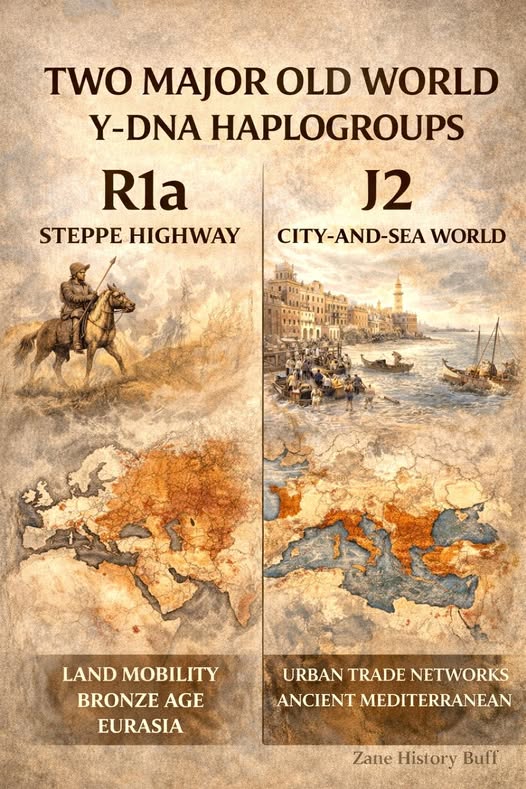


Bookmarks