Page 2 of 2 FirstFirst 12
Results 11 to 15 of 15

Thread: Scale of Polonization of Germans in Wielkopolska

  1. #11
    Veteran Member Apricity Funding Member
    "Friend of Apricity"

    rothaer's Avatar
    Join Date
    Apr 2019
    Last Online
    @
    Ethnicity
    German
    Ancestry
    Eastern German
    Country
    Germany
    Gender
    Posts
    7,867
    Thumbs Up/Down
    Received: 8,455/56
    Given: 8,712/5

    1 Not allowed! Not allowed!

    Default

    Quote Originally Posted by Peterski View Post
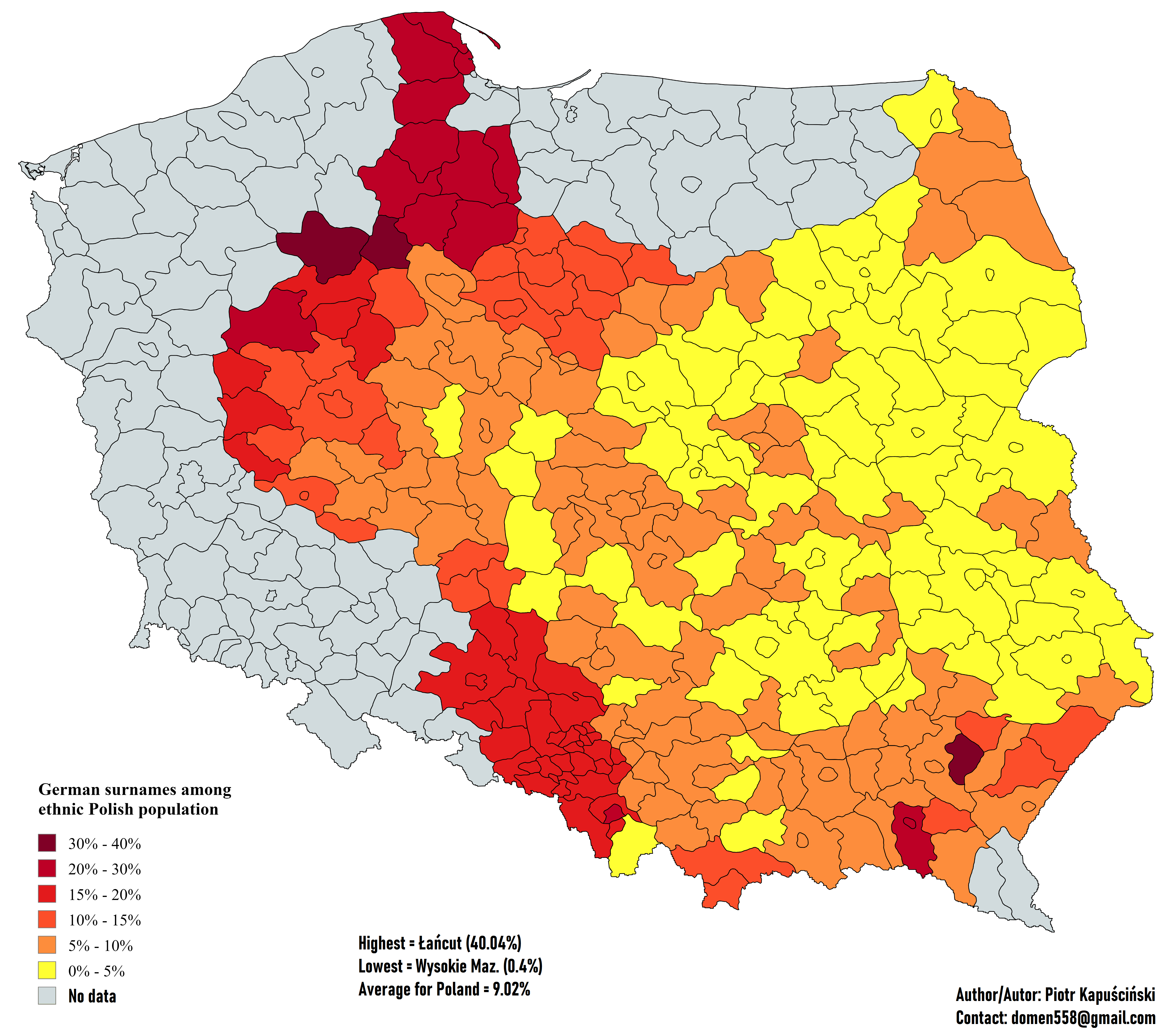
    I made a map of German surnames among Poles based on research by Olszak-Przytycki from forum.gazeta.pl (from "Nazwiska Polski" subforum).

    Several caveats:

    1. He did not research the Regained Lands (except for the Upper Silesian part), so there is only data for areas within pre-1939 borders of Poland.
    2. For some regions he did not publish data by county, but only for entire regions, so I painted all counties of these regions with the same colour.
    3. Such regions are: Upper Silesia, Pomerelia, Kashubia (part within pre-1939 Poland), Kuyavia and Land of Chelmno-Dobrzyn-Lubawa-Michalowo.
    4. For Upper Silesia he published two conflicting estimates: 13% and 17%. So I asked him, and he replied that 15-16% is the most accurate value.

    5. For Kashubia I took the data from Rebala et al. 2013 (around 25% of German surnames).
    6. For Cieszyn Silesia I took the data from this publication (which says: around 15%) - LINK.


    Areas with the highest percentages of German surnames among Poles correlate with areas which had ethnically mixed (Polish-German) population for the longest time - Royal Prussia (which was from 1309-1454 under Teutonic rule), Krajna (north-western Wielkopolska). The rest of Wielkopolska also has high percentages even though I think that the High Medieval (1200s-1300s) German settlement there was completely Polonized, and German communities which existed in Wielkopolska later were descended from another wave of immigration (those coming between the 1500s and the 1800s). Among Silesians there is also a substantial percent of German surnames (13-17%) even though counties such as Bytom/Beuthen, Lubliniec/Lublinitz, Strzelce Opolskie/Gross Strehlitz, Olesno/Rosenberg, Pszczyna/Pless and Rybnik were almost completely Polish in the early 1800s (percentages of Polish-speaking population in these counties in the 1st half of the 19th century were, respectively, 95%, 94%, 94%, 93%, 94% and 94%). But it is probable that some German surnames in the Prussian Partition and in Upper Silesia were the result of administrative Germanization of surnames rather than actual German ancestry. BTW, most of my nine Wielkopolska samples are from these areas of Wielkopolska which have below average (5-10%) share of German surnames.
    A very nice map!

    German surnames became fixated at abt. 1350 +/- 100 years (the regional variation is even bigger). Polish far later IMO. It would be interesting to know if a German with a German fixated surname, that became Polonised in 1300 AD lost his German surname and got a fixated Polish one in 1500 AD (figuratively).
    Last edited by rothaer; 05-09-2026 at 12:38 AM.
    Target: rothaer_scaled
    Distance: 1.0091% / 0.01009085

    39.8 (Balto-)Slavic
    39.0 Germanic
    19.2 Celtic-like
    1.8 Graeco-Roman
    0.2 Finnic-like

  2. #12
    Veteran Member
    Apricity Funding Member
    "Friend of Apricity"


    Join Date
    Jul 2014
    Last Online
    Today @ 02:45 AM
    Location
    Pole position
    Meta-Ethnicity
    Slavic
    Ethnicity
    Polish
    Country
    Poland
    Y-DNA
    R1b-BY194358
    mtDNA
    W6a
    Gender
    Posts
    24,567
    Thumbs Up/Down
    Received: 23,744/744
    Given: 20,581/1,184

    1 Not allowed! Not allowed!

    Default

    Quote Originally Posted by rothaer View Post
    A nice consideration, thanks! I've two comments.

    1. From when are your Wielkopolska Medieval samples? I only ask for excluding the possibility that they are fresh immigrants that still lived beside possible restgermanen and now are a selection from the whole population. I'd say if they are from after 900 AD we are safe and likely even when they are from after 800 AD.
    The age of these 36 samples is 1100-1200 AD, the average age is 1100 AD (and the average age of every individual sample is also 1100 AD, except one sample for which it is 1089 AD and one for which it is 1171 AD). So I think we can agree that it is unlikely that any Restgermanen survived for such a long time still unmixed with the Slavic population.

    Quote Originally Posted by rothaer View Post
    2. "I used Dutch because the German average has Slavic admixture, and I assume that Ostsiedlung settlers didn't yet have it":

    This will just apply to the earliest ostsiedlung settlers. Later ostsiedlung Germans mostly came from neigbouring areas and they will have comprised a Slavic admixture (of uncertain level). As a general take you can say the far more east, the later was the settlment.

    Do you recall some statements on Gluchoniemcy? They will have been notably Slavic and hailed from East Thuringia etc. I think you can even deduce that from the Landshut/Lancut genetics in combination with the high proportion of German surnames (another map of you showed that).

    I'm aware that all this makes the assumed ethnic German contribution in Wielkopolska even higher.
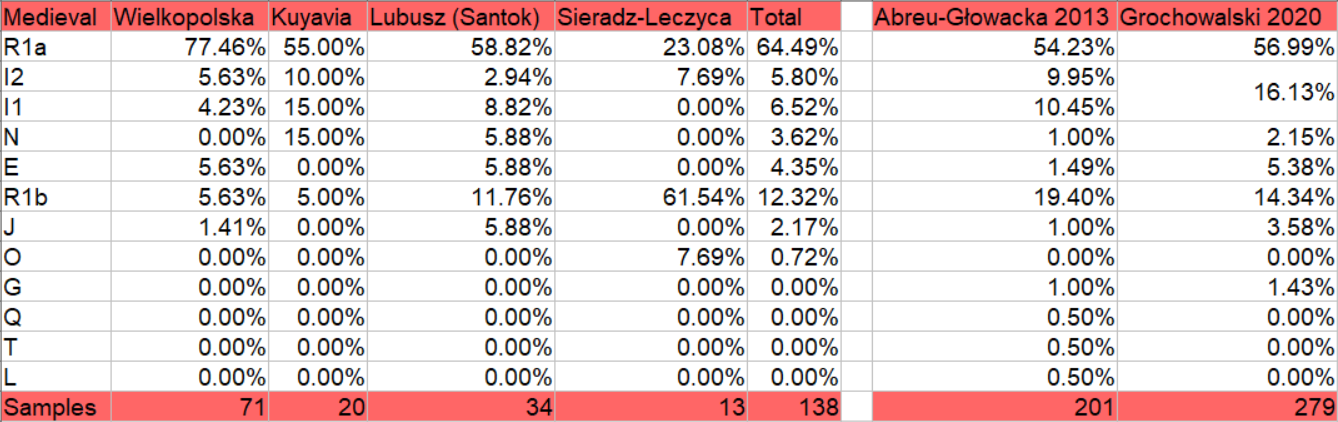
    Okay I agree. However my assumption was that Poles from Wielkopolska Polonized mostly that early wave of German settlers (who probably still had no Slavic admixture or just a small amount). By the way a comparison of Early Medieval Wielkopolska and Modern Wielkopolska Y-DNA haplogroups also shows that there must have been German admixture.

    (I included Kuyavia, Santok & Sieradz-Leczyca Land as they are sometimes considered parts of Wielkopolska)
    (however, modern percentages from Abreu-Głowacka and Grochowalski are just for Wielkopolskie Voivodeship)


    Modern figures are from Abreu-Głowacka 2013 study (interpreted by Michal Milewski) and Grochowalski 2020:

    https://www.termedia.pl/Badania-popu...23736,1,0.html
    https://www.frontiersin.org/journals...20.567309/full

    Michal's interpretation - https://genoplot.com/discussions/post/717011

    Early Medieval samples can be found in my Google Spreadsheet here:

    https://docs.google.com/spreadsheets...it?usp=sharing

    Sieradz-Leczyca samples are mostly from Lutomiersk, where there is a very high proportion of R1b (7 out of 10).
    My DNA Origin analysis for 16 EUR (you get 2 reports examining ancestry from 3012 regions, 226 countries): https://www.exploreyourdna.com/DNAOrigin.aspx

    This analysis is not based on G25 but on ADMIXTURE. And it has more regions than any other DNA test!

  3. #13
    Veteran Member Apricity Funding Member
    "Friend of Apricity"

    rothaer's Avatar
    Join Date
    Apr 2019
    Last Online
    @
    Ethnicity
    German
    Ancestry
    Eastern German
    Country
    Germany
    Gender
    Posts
    7,867
    Thumbs Up/Down
    Received: 8,455/56
    Given: 8,712/5

    0 Not allowed! Not allowed!

    Default

    Quote Originally Posted by Peterski View Post
    The age of these 36 samples is 1100-1200 AD, the average age is 1100 AD (and the average age of every individual sample is also 1100 AD, except one sample for which it is 1089 AD and one for which it is 1171 AD). So I think we can agree that it is unlikely that any Restgermanen survived for such a long time still unmixed with the Slavic population.


    Okay I agree. However my assumption was that Poles from Wielkopolska Polonized mostly that early wave of German settlers (who probably still had no Slavic admixture or just a small amount). By the way a comparison of Early Medieval Wielkopolska and Modern Wielkopolska Y-DNA haplogroups also shows that there must have been German admixture.

    (I included Kuyavia, Santok & Sieradz-Leczyca Land as they are sometimes considered parts of Wielkopolska)
    (however, modern percentages from Abreu-Głowacka and Grochowalski are just for Wielkopolskie Voivodeship)


    Modern figures are from Abreu-Głowacka 2013 study (interpreted by Michal Milewski) and Grochowalski 2020:

    https://www.termedia.pl/Badania-popu...23736,1,0.html
    https://www.frontiersin.org/journals...20.567309/full

    Michal's interpretation - https://genoplot.com/discussions/post/717011

    Early Medieval samples can be found in my Google Spreadsheet here:

    https://docs.google.com/spreadsheets...it?usp=sharing

    Sieradz-Leczyca samples are mostly from Lutomiersk, where there is a very high proportion of R1b (7 out of 10).
    Thanks.

    And: Whatever new hints do come on this topic, it goes all in the same direction: There was no relevant proportion of restgermanen. The demographic disaster in the eastern half of Germania Magna was complete.
    Target: rothaer_scaled
    Distance: 1.0091% / 0.01009085

    39.8 (Balto-)Slavic
    39.0 Germanic
    19.2 Celtic-like
    1.8 Graeco-Roman
    0.2 Finnic-like

  4. #14
    Veteran Member
    Apricity Funding Member
    "Friend of Apricity"


    Join Date
    Jul 2014
    Last Online
    Today @ 02:45 AM
    Location
    Pole position
    Meta-Ethnicity
    Slavic
    Ethnicity
    Polish
    Country
    Poland
    Y-DNA
    R1b-BY194358
    mtDNA
    W6a
    Gender
    Posts
    24,567
    Thumbs Up/Down
    Received: 23,744/744
    Given: 20,581/1,184

    0 Not allowed! Not allowed!

    Default

    Quote Originally Posted by rothaer View Post
    Thanks.

    And: Whatever new hints do come on this topic, it goes all in the same direction: There was no relevant proportion of restgermanen. The demographic disaster in the eastern half of Germania Magna was complete.
    Yeah if Proto-Slavs were Belarusian-like and Pre-Ostsiedlung Wielkopolska are also Belarusian-like, then there is not much room for Restgermanen admixture. Only if Proto-Slavs were Lithuanian-like then a quite significant admixture would be possible.
    My DNA Origin analysis for 16 EUR (you get 2 reports examining ancestry from 3012 regions, 226 countries): https://www.exploreyourdna.com/DNAOrigin.aspx

    This analysis is not based on G25 but on ADMIXTURE. And it has more regions than any other DNA test!

  5. #15
    Apricity Funding Member
    "Friend of Apricity"


    Join Date
    Dec 2025
    Last Online
    @
    Ethnicity
    HR
    Country
    Croatia
    Gender
    Posts
    209
    Thumbs Up/Down
    Received: 257/4
    Given: 57/1

    0 Not allowed! Not allowed!

    Default

    Quote Originally Posted by Peterski View Post
    Yeah if Proto-Slavs were Belarusian-like and Pre-Ostsiedlung Wielkopolska are also Belarusian-like, then there is not much room for Restgermanen admixture. Only if Proto-Slavs were Lithuanian-like then a quite significant admixture would be possible.
    Belarusians have a huge ethnic Baltic admixture that can be quantitatively mapped by the evidence: frequency of Y-DNA N1c increases in a direction towards the Lithuanian and Latvian borders and decreases in a direction toward the Ukrainian border.

    Something is wrong with Wielkopolska_Medieval samples.

Thread Information

Users Browsing this Thread

There are currently 1 users browsing this thread. (0 members and 1 guests)

Similar Threads

  1. Polish R1b-Z2103 from Kuyavia/Wielkopolska borderland
    By Peterski in forum Autosomal DNA
    Replies: 7
    Last Post: 07-08-2021, 03:55 PM

Bookmarks

Posting Permissions

  • You may not post new threads
  • You may not post replies
  • You may not post attachments
  • You may not edit your posts
  •