

0





| Thumbs Up/Down |
| Received: 79/0 Given: 37/0 |
 Long IBD shared segments of European ethnic groups with Poles.
Source: Davidski and The Society for Molecular Biology and Evolution (SMBE).
Source link: http://polishgenes.blogspot.com/2012...igrations.htmlLong IBD gives clues to migrations across Europe from the Bronze Age to the present (aka. SMBE 2012 abstracts)
The Society for Molecular Biology and Evolution (SMBE) is holding a major conference this week, and has released a rather large PDF of abstracts of the presentations at the meeting. Most of these presentations are yet to be published as articles in journals, but after a bit of Googling, I think I located one of them online. Luckily, it just happens to be the one I’m most interested in…
Long IBD in Europeans and recent population history
Peter Ralph, Graham Coop
UC Davis, Davis, CA, USA
Numbers of common ancestors shared at various points in time across populations can tell us about recent demography, migration, and population movements. These rates of shared ancestry over tens of generations can be inferred from genomic data, thereby dramatically increasing our ability to infer population history much more recent than was previously possible with population genetic techniques. We have analyzed patterns of IBD in a dataset of thousands of Europeans from across the continent, which provide a window into recent European geographic structure and migration.
Unfortunately, the link doesn’t include much data, but has lots of impressive graphics. I’ve put together a small selection of these, focusing on…surprise, surprise…Poland. Basically, the larger the circle, the more Identity-by-descent (IBD) shared:
I think t’s very clear from the results that the Polish sample shares a lot of fairly recent IBD with many groups from across Europe, and especially those from north and east of the Alps. Most of these segments were certainly spread by various Indo-European groups, including the Slavs.
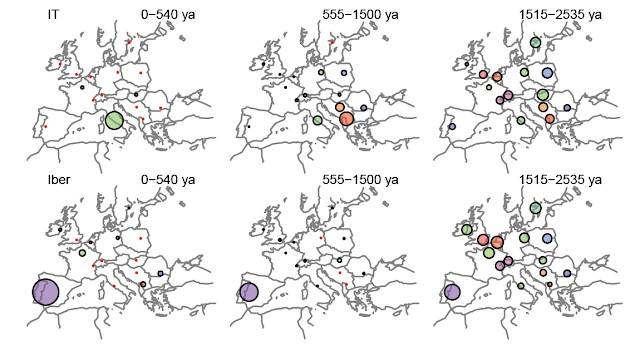
The authors have attempted to estimate the ages of the admixtures, and divided the results into three periods. The outcomes for Poland appear very accurate based on what we know from history and archaeology, although keep in mind that East Slavic individuals are missing from this part of the analysis. I’ve also included the graphics for Italy (IT) and Iberia (Iber), for comparison. The results for these two Southern European regions look much more conservative, and I suspect that’s due to their larger effective population sizes, plus the Alps and Pyrenees acting as strong barriers to gene flow from the north.
At the 0-540 ya period, Poles don’t share much with anyone except with each other and Germans. This makes sense, considering, for instance, the heavy migration of Poles from regions under Prussian occupation to the German industrial areas of the Ruhr and Saxony. These people were quickly Germanised and absorbed by the locals. Today, only their Polish sounding names and diluted genes remain.
I think the 555-1500 ya graphic very clearly shows the effects of the Slavic expansion, probably at least partly from the territory of modern Poland. I suspect the same expansion can also be seen on the 1515-2353 ya graphic. But here we can also likely see the effects of several other major population movements, including migrations of the Celts, Germanics, and even possibly late Corded Ware groups. In any case, looking at all those large “Slavic” bubbles in the Balkans, I’m reminded of this quote from Procopius.
Illyria and all of Thrace, that is, from the Ionian Gulf to the suburbs of Constantinople, including Greece and the Chersonese, were overrun by the Huns, Slavs and Antes, almost every year, from the time when Justinian took over the Roman Empire; and intolerable things they did to the inhabitants. For in each of these incursions, I should say, more than two hundred thousand Romans were slain or enslaved, so that all this country became a desert like that of Scythia.
Eventually, the Slavs stopped raiding the Balkans and settled there permanently. Many became subjects of the Roman Empire.
It’d be fascinating if an IBD analysis like this was carried out on an expanded dataset, including many more samples from Northern and Eastern Europe, as well as West and Central Asia. We know there were movements of people from Europe deep into Asia during the metal ages, and learning more about these events could help us unravel the origins of such enigmatic groups as the early Indo-Europeans.
Actually, there’s another abstract in that SMBE selection, and this one is dealing with Identity-by-state (IBS) tracts in Europeans. It claims there’s been” no significant gene flow between Europeans and Asians within the past few hundred generations”. That sounds like a reasonable statement, but only in the context of the 1000 Genomes samples these scientists compared, which I assume included Europeans vs. South and East Asians. So like I say, what we really need is a study of IBD or IBS, or both, that looks at a wider variety of groups from West and Central Asia, because that’s where most of the relatively recent mixing took place.
Reconstructing demographic histories from long tracts of DNA sequence identity
Kelley Harris1, Rasmus Nielsen1,2
1UC Berkeley, Berkeley, CA, USA, 2University of Copenhagen, Copenhagen, Denmark
There has been recent excitement and debate about the details of human demographic history, involving gene flow that has occurred between populations as well as the extent and timing of bottlenecks and periods of population growth. Much of the debate concerns the timing of past admixture events; for example, whether Neanderthals exchanged genetic material with the ancestors of non-Africans before before or after they left Africa. Here, we present a method for using sequence data to jointly estimate the timing and magnitude of past genetic exchanges, along with population divergence times and changes in effective population size. To achieve this, we look at the length distribution of regions that are shared identical by state (IBS) and maximize an analytic composite likelihood that we derive from the sequentially Markov coalescent (SMC). Recent gene flow between populations leaves behind long tracts of identity by descent (IBD), and these tracts give our method its power by influencing the distribution of shared IBS tracts. However, since IBS tracts are directly observable, we do not need to infer the precise locations of IBD tracts. In this way, we can accurately estimate admixture times for relatively ancient events where admixture mapping is not possible, and in simulated data we show excellent power to characterize admixture pulses that occurred 100 to several hundred generations ago. When we study the IBS tracts shared between and within the populations sequenced by the 1000 Genomes consortium, we find evidence that there was no significant gene flow between Europeans and Asians within the past few hundred generations. It also looks unlikely that the Yorubans of Nigeria interbred with Europeans or Asians in a population-specific way, though there may have been admixture between Africans and an ancestral non-African population.
I think this was a great scientific study done by the SMBE. I also want to give a great big thank you to Davidski for posting this and giving his insights about it at his blog!
My thoughts: This shows the ancestral similarities and relatedness between many ethnic groups of Europe to Poles. The IBD (Identical by Descent) DNA segments shared with Poles and other Europeans shows the relatedness other European ethnicities had/have with Poles and the common ancestors they share over tens of generations.
In Western/Northern Europe the Germans, Swedes, and Danes share the most IBD segments with the Poles.
I would really like to hear all of your insights on this study!
Last edited by The Exiled King; 06-26-2012 at 02:37 PM.

| Thumbs Up/Down |
| Received: 281/33 Given: 9/5 |
cool, i feel like an ubermensch




| Thumbs Up/Down |
| Received: 23,756/744 Given: 20,599/1,184 |
Here is graphical representation of that data:
http://www.cmap.polytechnique.fr/~an...PPGE/Ralph.pdf
https://arxiv.org/pdf/1207.3815.pdf
http://journals.plos.org/plosbiology...l.pbio.1001555
For comparison data for Italians and Iberians:
My DNA Origin analysis for 16 EUR (you get 2 reports examining ancestry from 3012 regions, 226 countries): https://www.exploreyourdna.com/DNAOrigin.aspx
This analysis is not based on G25 but on ADMIXTURE. And it has more regions than any other DNA test!
There are currently 1 users browsing this thread. (0 members and 1 guests)
 Posting Permissions


 Reply With Quote
Bookmarks