

0


| Thumbs Up/Down |
| Received: 4,477/93 Given: 3,569/34 |

This is the tale of the meeting of a Briton (George Burrow) with an Iberian crypto-Jew, as told by him, text quoted by Cecil Roth in his "A History of the Marranos":
George Borrow, the imaginative purveyor of the Bible in Spain, gives an extraordinary account of personal encounter in 1835, during his visit to the Peninsula. Having regard for the exuberant fancy of the author, this was universally regarded as a characteristic piece of romancing. There is perhaps more in it than was at one time thought; and it is worthwhile to cite it at length:
"There was something peculiarly strange about the figure: . . . I see him standing in the moonshine, staring me in the face with his deep calm eyes. At last he said — “Are you then one of us?'
Myself: You say you are wealthy. In what does your wealth consist?
Abarbenel: In gold and silver, and stones of price; for I have inherited all the hoards of my forefathers. The greater part is buried underground; indeed, I have never examined the tenth part of it. I have coins of silver and gold older than the times of Ferdinand the Accursed and Jezebel; I have also large sums employed in usury. We keep ourselves close, however, and pretend to be poor, miserably so; but, on certain occasions, at our festivals, when our gates are barred, and our savage dogs are let loose in the court, we eat our food off services such as the Queen of Spain cannot boast of, and wash our feet in ewers of silver, fashioned and wrought before the Americas were discovered, though our garments are at all times course, and our food for the most part of the plainest description . . .
Myself: Are you known for what you are? Do the authorities molest you?
Abarbenel: People of course suspect me to be what I am; but as I conform outwardly in most respects to their ways, they do not interfere with me. True it is that sometimes, when I enter the church to hear the mass, they glare at me over the left shoulder, as much as to say —'What do you here?' And sometimes they cross themselves as I pass by; but as they go no further, I do not trouble myself on that account . . .
Myself: Do the priests interfere with you?
Abarbenel: They let me alone, especially in our own neighbourhood. Shortly after the death of my father one hot-headed individual endeavoured to do me an evil turn; but I soon requited him causing him to be imprisoned on a charge of blasphemy, and in prison he remained a long time, till he went mad and died.
Myself: Have you a head in Spain, in whom is vested the chief authority?
Abarbenel: Not exactly. There are, however, certain holy families who enjoy much consideration; my own is one of these the chiefest, I may say. My grandsire was a particularly holy man; and I have heard my father say, that one night an archbishop came to his house secretly, merely to have the satisfaction of kissing his head.
Myself: How can that be? What reverence could an archbishop entertain for one like yourself or your grandsire?
Abarbenel: More than you imagine. He was one of us, at least his father was, and he could never forget what he had learned with reverence in his infancy . . . he then returned to his diocese, where he shortly afterwards died, in much renown for sanctity.
Myself: What you say surprises me. Have you reason to suppose that many of you are to be found amongst the priesthood?
Abarbenel: Not to suppose, but to know it. There are many such as I amongst the priesthood, and not amongst the inferior priesthood either; some of the most learned and famed of them in Spain have been of us, or of our blood at least, and many of them at this day think as I do. There is one particular festival of the year at which four dignified ecclesiastics are sure to visit me; and then, when all is made close and secure, and the fitting ceremonies have been gone through, they sit down upon the floor and curse.
Myself: Are you numerous in the large towns?
Abarbenel: By no means; our places of abode are seldom the large towns; we prefer the villages and rarely enter the large towns but on business. Indeed, we are not a numerous people, and there are few provinces of Spain which contain more than twenty families. None of us are poor, and those among us who serve, do so more from choice than necessity, for by serving each other we acquire different trades. Not unfrequently the time of service is that of courtship also, and the servants eventually marry the daughters of the house . . ."


| Thumbs Up/Down |
| Received: 1,788/24 Given: 1,596/62 |
Or per Example;Originally Posted by Alex Delarge

"Tas a judiar......"
| Thumbs Up/Down |
| Received: 4,477/93 Given: 3,569/34 |
According to a 2001 poll among the people of Majorca, 30% answered they'd never marry a Xueta, and 5% said they did not want to have Xueta friends.
http://es.wikipedia.org/wiki/ChuetaTodo ello, sin embargo, no implica la eliminación completa de conductas de rechazo, como indica una encuesta realizada entre los mallorquines por la Universidad de las Islas Baleares en 2001, en la que un 30% afirmó que no se casaría nunca con un/una chueta y un 5% declaró que no desea ni tener amigos chuetas
Pic of a famous Xueta, Miquel Segura (journalist, writer and jeweller), who has returned to Judaism:
http://es.wikipedia.org/wiki/Miquel_Segura_Aguil%C3%B3Miquel Segura Aguiló (La Puebla, Islas Baleares, 25 de enero de 1945) es un periodista, escritor y joyero español, de origen chueta. Es el padre del diplomático español Jaume Segura.
Nació en La Puebla, en el interior de la isla de Mallorca, en el seno de una ilustre familia de joyeros y plateros pertenecientes a la minoría chueta, un grupo de descendientes de judíos conversos mallorquines que por causa de las persecuciones religiosas y su posterior estigmatización a fines del siglo XVII se vieron obligados a practicar una estricta endogamia, a la vez que conservaron una sólida conciencia colectiva. Periodista autodidacta, ha colaborado desde 1981 en diferentes publicaciones de Baleares, entre ellos Ultima Hora, donde mantiene una columna periódica. También escritor prolífico, mayoritariamente en catalán, cultivó todos los géneros literarios a excepción del teatro.
Siendo consciente de su origen chueta, la aventura literaria de Miquel Segura con los años se profundiza en su identidad primero conversa, y luego judía. Su primer libro de la temática, Memòria xueta (Memoria chueta, de 1994) marcó un antes y un después en el tratamiento de la cuestión chueta en Mallorca, ya que rompió definitivamente con un estigma que la sociedad balear arrastraba desde hace centurias, al ponerla en el centro de la opinión pública. Habitual entrevistado, participante de programas de televisión, y ponente en diversos seminarios internacionales, su caso (y el de muchos otros) ha trascendido fronteras, llegando a oídos del Gran Rabino de Israel.
El 17 de diciembre de 2009 Miquel Segura retorna oficialmente al judaísmo, en una ceremonia efectuada en Nueva York, y adopta el nombre hebreo de Mihael Bar Haim. Es la primera persona de origen chueta que desde los tiempos de la Inquisición se le reconoce su retorno al judaísmo sin pasar por una conversión religiosa.


| Thumbs Up/Down |
| Received: 25,709/1,991 Given: 23,913/1,658 |
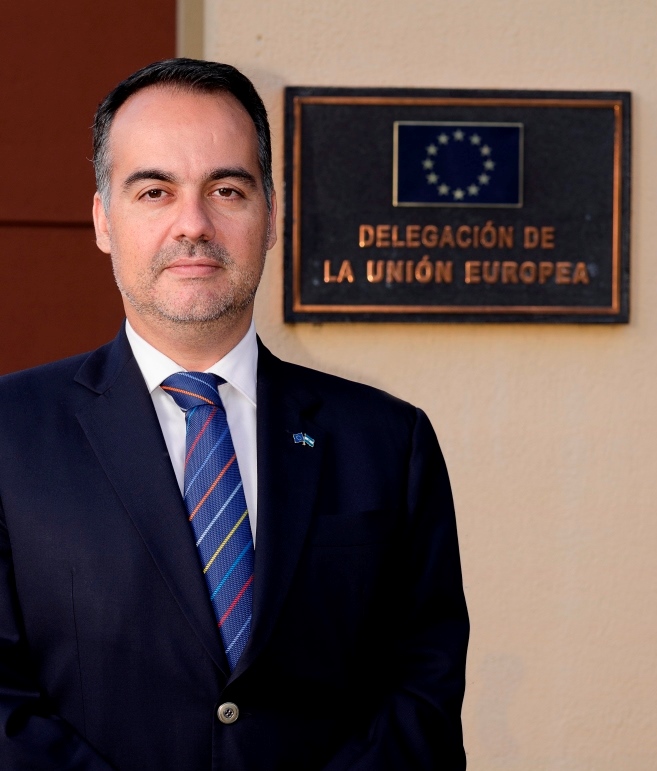
His son Jaume Segura
| Thumbs Up/Down |
| Received: 4,477/93 Given: 3,569/34 |
A documentary on the Xuetas telling the story of Miquel Segura too:
https://www.youtube.com/watch?v=YyQYOUDE24w
Two other pics of the Xueta (now returned Jew) Miquel Segura (he could easily pass for a stereotypical Jew, either Sephardic or Ashkenazi):

Last edited by curupira; 08-07-2014 at 09:40 PM.
| Thumbs Up/Down |
| Received: 4,477/93 Given: 3,569/34 |
This is a film about Antonio José da Silva, "o Judeu" ("the Jew"). He was born in Rio de Janeiro into a New Christian family. He was later executed by the Inquisition. I wonder where he would plot in a genetic map.
http://en.wikipedia.org/wiki/Ant%C3%...C3%A9_da_SilvaAntónio José da Silva Coutinho. (8 May 1705 – 18 October 1739) was a Brazilian dramatist, known as "the Jew" (O Judeu). The Brazilian spelling of his first name is Antônio, António José da Silva in Hebrew אנטוניו ז'וזה דה סילווה.
His parents, João Mendes da Silva and Lourença Coutinho, were descended from Jews who had emigrated to the colony of Brazil to escape the Inquisition, but in 1702 that tribunal began to persecute the Marranos or anyone of Jewish descent in Rio, and in October 1712 Lourença Coutinho became a victim. Her husband and children accompanied her to Portugal, where she figured among the "reconciled" in the auto-da-fé of July 9, 1713, after undergoing the torment only.
Her husband, having then acquired a fixed domicile in Lisbon, settled down to advocacy with success, and he was able to send António to the University of Coimbra, where he matriculated in the faculty of law. In 1726 António was suddenly imprisoned along with his mother on August 8; on the 16th he suffered the first interrogation, and on September 23 he was put to the torment, with the result that three weeks later he could not sign his name. He confessed to having followed the practices of the Mosaic law, and this saved his life.
He went through the great auto-da-fé held on October 23 in the presence of King John V and his court, abjured his errors, and was set at liberty. His mother was only released from prison in October 1729, after she had undergone torture and figured as a penitent in another auto-da-fé.
Meanwhile António had gone back to Coimbra, and finishing his course in 1728–1729 he returned to Lisbon and became associated with his father as an advocate. He found what he believed to be an ignorant and corrupt society ruled by an immoral yet fanatical monarch, who wasted millions on unprofitable buildings though the country was almost without roads and the people had become the most backward in Europe. As his plays show, the spectacle struck António's observation, but he had to criticize with caution.
He produced his first play or opera in 1733, and the next year he married his cousin, D. Leonor Maria de Carvalho, whose parents had been burnt by the Inquisition, while she herself had gone through an auto-da-fé in Spain and been exiled on account of her religion. They had their first daughter in 1734, but the years of their happiness and of Silva's dramatic career were few, for on October 5, 1737 husband and wife were both imprisoned on the charge of "judaizing." A slave of theirs had denounced them to the Holy Office. Though the details of the accusation against them seemed trivial and contradictory, and some of his friends testified about his Catholic piety and observation, António was condemned to death. On October 18, like those who wanted to die in the Catholic faith, he was first strangled and after had his body burnt in an auto-da-fé. His wife, who witnessed his death, did not long survive him.[1]
| Thumbs Up/Down |
| Received: 4,477/93 Given: 3,569/34 |
This is from a recent genetic study focusing on the crypto-jews from Belmonte and Bragança (among Belmonte crypto-jews haplogroup J is the very predominant male lineage, unlike among the Portuguese population in general):
http://journal.frontiersin.org/Journ...00012/abstractThe purpose of this review is to summarize and critically revise the existing genetic data concerning the Portuguese Sephardic Jewish population. In this regard, other Sephardic population studies will be reviewed for contextualization. The historical background of the Sephardic Jews, with an emphasis on the Portuguese history, will be addressed. With the exception of the studies on the Chuetas, an isolated Mallorcan community from the Moslem period, 10th to 13th centuries (Santamaría Arández, 1997), currently available genetic studies on the original population from Iberia are restricted to Portugal, namely to Belmonte municipality and Bragança district (Northeast Portugal). Until the decree of expulsion and the establishment of the Inquisition in Portugal during the 15th century, the Portuguese Jewish communities had quite a similar history. From the 15th century on, however, most of the Portuguese Jews were either exiled, or assimilated into the general population with the exception of a few Crypto-Jewish communities. The Crypto-Jewish phenomenon is defined as the secret adherence to Judaism while publicly professing another faith. These communities have kept, for more than 500 years, their hidden religious practices and their cultural identity using complex social strategies. Among these communities, special mention is due to Belmonte, a small town in the center of Portugal and also to several small villages and towns in the Bragança district.
Uniparental genetic markers were typed in both communities (Adams et al., 2008;Nogueiro et al., 2010;Teixeira et al., 2011;Nogueiro et al., 2014), showing genetic profiles and levels of genetic diversity in accordance with their dissimilar recent history compared to the Portuguese general population.
In conclusion, the demographic processes underlying the genetic pool of the Portuguese Crypto-Jews descendants studied so far, are much more complex than would be expected under the classical model of extreme inbreeding and drift, with consequent loss of genetic diversity. The contrasting patterns observed in Bragança community and Belmonte are enough to sustain that whatever the results of future studies, no simple and uniform evolutionary model will accommodate the sharp heterogeneity already observed. Notwithstanding this difference, both groups display a genetic pool clearly showing contributions of European and Near Eastern lineages, in accordance with a significant persistence of a Jewish heritage, translated in a conscience of belonging to a distinctive community. This ancestry was detected within both male and female lineages, indicating that introgression from and admixture with the host population does seem to have been significantly gender biased. Moreover, the high genetic diversity found in Bragança demonstrates that there was neither a low number of founder lineages, nor a significant reduction of effective population size as indeed occurred in Belmonte. It remains to be explained how this resistance to genetic erosion, as expected in endogamous, small sized populations, was achieved, that is to say, what mating strategies were undertaken by these communities which ensured a steady gene flow between them, counteracting the expected inbreeding.
New data from recombining genetic markers in the line of Behar et al. (2010), as well as from classical genealogical studies, will surely contribute decisively to explain how this was achieved. At any rate, the DNA evidence gathered so far adds a new facet to the already recognized astonishing cultural resistance of these communities: not only they have kept a sense of belonging throughout centuries of persecution but they also succeeded in maintaining a genetic heritage of their own.
Last edited by curupira; 01-22-2015 at 12:18 PM.



| Thumbs Up/Down |
| Received: 4,807/242 Given: 6,085/105 |
There are somes Jews in Portugal until today. And some Crypto-Jews, especialy politicians and Media guys. The majority of them are Free-Massons.
We must never forget the connection beetween Judaism and Massonry.
| Thumbs Up/Down |
| Received: 4,477/93 Given: 3,569/34 |
Books about it:
"Os judeus secretos em Portugal" ("The secret Jews in Portugal") by Amilcar Paulo:
http://servidormix.com/~redejudi/ima...emportugal.pdf
"A history of the Marranos" by Cecil Roth:
http://www.redejudiariasportugal.com...cil%20Roth.pdf
"História dos cristãos novos portugueses" ("History of the Portuguese New Christians"), by J. Lúcio de Azevedo:
https://ia600500.us.archive.org/21/i...hris00azev.pdf
"Centinela contra judíos" ("Watchtower against jews"), by Fray Francisco de Torrejoncillo (a propaganda pamphlet agains new christians, contemporary to that time):
http://es.wikipedia.org/wiki/Centine...ra_jud%C3%ADos
http://historiayverdad.org/Babilonia...tra-judios.pdf
Last edited by curupira; 03-25-2015 at 12:31 PM.
| Thumbs Up/Down |
| Received: 7,868/61 Given: 4,233/127 |
Xuetas are not crypto-Jews anymore neither identify as Jews ethnically or religiously. They are either Catholic or Atheists, and only a few of them have returned to Judaism.
There are currently 1 users browsing this thread. (0 members and 1 guests)
 Posting Permissions

 Reply With Quote


Bookmarks