

0





| Thumbs Up/Down |
| Received: 21/3 Given: 0/0 |

The Language of southern Scandinavia in the Bronze Age:
Fenno-Ugric, Baltic, Germanic, or ...? Claes-Christian Elert. He's not your average Joe but a Professor Emeritus in linguistics.
What's your opinion on this, Jaska?The absence of any great dialect split in the Germanic language spoken in Scandinavia and northern Germany at the time of the earliest written sources (ca. 200-500 A.D.) indicates strongly that a Germanic language has been spoken over such a large area for only a short time. The late Bronze Age (ca. 700 B.C.) was a time of cultural change when the language(s) spoken earlier may have been replaced by the Germanic language.
..................
..................
On archeological, genetic and linguistic grounds the late Bronze Age language in Scandinavia could have been a Finnic or Baltic language (or both). However, from what can be inferred from parallels in history or ethnolinguistics a more complicated and varied pattern is the most likely one in subglacial Europe at the end of the Ice Age after tens of thousands of years of human settlement or, later, in Bronze Age Scandinavia, after 7-8 millennia. The better-known linguistic situation in early cultures, such as southern Europe and Anatolia in the first two millennia B.C., shows a complicated pattern of IE and non-IE languages together with languages with unknown relationship, most of them spoken over restricted areas, and often subject to swift change. This is true also about cultures of a similar level of development in many parts of the world. There is archeological evidence in Bronze Age Sweden of a tribal community which is not incompatible with this language pattern (Larsson 1986; Nordström 1992; Wigren 1987).
| Thumbs Up/Down |
| Received: 32/4 Given: 2/0 |
Yes, they are. Foreigner would immediately recognize the common features, just like in the case of Slavic or Scandinavian languages. Mutual intelligibility is the criteria only if we talk about the dialects of ONE language; it is not the criteria when we talk about a group of closely related languages.Originally Posted by Jäärapää
In the forum debates my opponents are on the level of Jäärapää – they are not linguists but laymen who have some early day fell in love with some theory and now opposite everything which contradicts it. I refer to my own writings, because I have done the collecting work; it is easier for everybody to read one article where all the points are, instead of reading dozen different articles where the points are. And it is easier to refer to an article than rewrite it again for the forum.
There are greater differences even between German and English than between any two Finnic languages – not to speak of the differences between Gothic, Swedish and English. So clearly the Finnic languages have differentiated later than Germanic languages, although earlier than the Scandinavian languages. And still you couldn’t understand Faroese (føroyskt) on the basis of Swedish.
And there are also other arguments (than just comparing the difference between the languages of different branches) which testify for the late separation of Finnic languages; see the downmost link below (and I already gave it earlier).
Yes, he is a phonetician, just like Wiik. He is not comparative linguist. But of course the arguments are the only thing that matter, so let’s see:
It’s true that majority of Scandinavia has only Scandinavized very late, only at the second millennium AD. And now (since 2004) we also know that there truly was a Palaeo-European substrate language (or even more of them) in northern Scandinavia. This language, however, seems to have had nothing in common with the Uralic, Finnic or Baltic languages (or Basque, or Sumerian, etc.).
What comes to the claim of Elert, that “On archeological, genetic and linguistic grounds the late Bronze Age language in Scandinavia could have been a Finnic or Baltic language (or both)”, this claim is just based on the invalid method, in which one assumes that archaeological or genetic continuity could testify for linguistic continuity, too. But this is a false assumption, and the invalidness of this method has been presented here:
http://www.mv.helsinki.fi/home/jphakkin/Uralic.html
Or in Finnish:
http://www.tieteessatapahtuu.fi/0106/hakkinen.pdf
So, what is the true linguistic evidence for the earlier Finnic or Baltic presence in Scandinavia? None. There is neither loanword stratum, nor place-name stratum from these languages in Scandinavia(n). Zero evidence. Nought. Nil. Saamic loanwords and place-names there are, of course, but they cannot predate the Proto-Saamic development which occurred in Southern Finland only 2 000 years ago. So, even the Saamic languages were not there during the Bronze Age, even though it was earlier thought so (based on the above-mentioned erroneous method).
http://www.mv.helsinki.fi/home/jphakkin/Jatkuvuus2.pdf

| Thumbs Up/Down |
| Received: 12/1 Given: 2/0 |
Based on my latest results, not really.
Western Finns and Balts do show affinity. But Western Finns are most similar Finns to North and Central Europeans, so this isn't a strong argument for Finnic influence in Balts, but rather Baltic and Germanic influence in Western Finns.



| Thumbs Up/Down |
| Received: 733/229 Given: 368/107 |
You should rename your "Finnic" group into Finnish. It's currently misleading. You might as well do a test with the Germanic people, but only use an Austrian sample. It would make as much sense.
In a way, Finns are peripheral Baltic-Finnish people, the proto-Finnic area was south-east of Finland and Estonians are less peripheral. There was a good article about this somewhere.

| Thumbs Up/Down |
| Received: 438/31 Given: 0/0 |
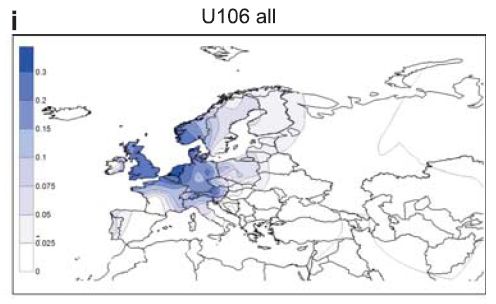
If anything it was I1 who were the docile peasents of Scandinavia being dominated by the aR1an's,btw R1b is quite frequent in Germanic speaking populations.
R1b1b2a1a1(R-U106)

| Thumbs Up/Down |
| Received: 12/3 Given: 0/0 |
Sure sure. Only a jealous baR1ba(wannabe)R1an would come with such nonsense.Let the haplogroup wars begin! It was about time!

| Thumbs Up/Down |
| Received: 21/3 Given: 0/0 |
Thanks, this was what I meant. The influence goes from the Balts to Finns and not the opposite.
But, what is the component in Balts which make them Balts (Latvians/Lithuanians --> Livs/Estonians --> Finns/Karelians)?
Clearly, it must be partially linked to the N1c (and the U5a) which is in fact is this ancient root population of Proto-Ur-Balto "Fininics".
| Thumbs Up/Down |
| Received: 21/3 Given: 0/0 |
It's only because the swarthy one's aren't as N1ce as the KI1ngs of the North.
| Thumbs Up/Down |
| Received: 21/3 Given: 0/0 |
Not everything in Wiik's theories is wrong, I think you agree wtih me here.
The idea to track a language, people and culture is best done by a multidisciplinary approach. It give contradicting results but it should do that! History is not simple, it's full of twists and turns.
I for sure don't understand a shit in Komi language but German and English is a piece of cake so I don't really understand this statement of yours (you don't have to tell me, I am a layman). Maybe you refer to the similiarities in grammar?There are greater differences even between German and English than between any two Finnic languages
But you must take the Finnic languages icebox effect into consideration !! The Finnic languages evolves slower.– not to speak of the differences between Gothic, Swedish and English. So clearly the Finnic languages have differentiated later than Germanic languages, although earlier than the Scandinavian languages. And still you couldn’t understand Faroese (føroyskt) on the basis of Swedish.
| Thumbs Up/Down |
| Received: 21/3 Given: 0/0 |
Thanks.
There are currently 1 users browsing this thread. (0 members and 1 guests)
 Posting Permissions

 Reply With Quote

Bookmarks