

0




| Thumbs Up/Down |
| Received: 44/6 Given: 18/1 |

Scythians were said to be very light skinned and light haired in contrast to the Greeks in ancient Greece. And also, in the area that is Kazakhstan, ancient Greeks named their population "savromatae" as far as I am aware, meaning serpent-eyed, in contrast to Scythae, who were the Scythians and according to folk mythology was a Greek-Amazon tribe.




| Thumbs Up/Down |
| Received: 5,382/129 Given: 6,047/229 |
ancient greeks also mentioned extreme ugliness of sarmatians as their characteristic in ancient textsOriginally Posted by Basileus


| Thumbs Up/Down |
| Received: 265/17 Given: 11/0 |
All these patterns on cotton and silk fabrics perhaps spread throughout Siberia not earlier than 1-2 millennia BC or much later with Chinese silk.
I think it's a bad idea to date this process by neolithic times.
Chinese dress:




| Thumbs Up/Down |
| Received: 18,470/411 Given: 11,902/296 |
Scythians were light skinned light haired white iranic peoples.
Face reconstructions:

| Thumbs Up/Down |
| Received: 265/17 Given: 11/0 |
Tatars are closer to north-western Finnic than to Volga Finnic - Erzya, Udmurt, Mari. This is expected, given the differences in haplogroups.
Last edited by Chelubey; 01-08-2019 at 04:01 PM.
| Thumbs Up/Down |
| Received: 18,470/411 Given: 11,902/296 |
Original iranic (aryan) race type:
http://humanphenotypes.net/ProtoNordid.html
| Thumbs Up/Down |
| Received: 265/17 Given: 11/0 |
I found a description of look of Kypchaks and Uigurs in the 15th (!) century in Chinese sources.
It found in comments to the law governing marriage unions (including with foreigners)
Ming Dynasty Laws:
http://www.vostlit.info/Texts/Dokume...frametext5.htm
Comments:
http://www.vostlit.info/Texts/Dokume...rimtext5.phtml
google translate:
Chinese racists!!!123 . Uighurs and Kipchaks are the most ugly among the Samuzhen ... Uigurs have curly hair and a big nose, Kipchaks have yellow hair and blue eyes. Their appearance is ugly and different [from ours], so ... it happens that the Chinese do not want to marry them.
| Thumbs Up/Down |
| Received: 18,470/411 Given: 11,902/296 |
Do you know why? Check this out:
https://en.wikipedia.org/wiki/Aryan#Proto-Indo-Iranian
https://en.wikipedia.org/wiki/Tocharians

| Thumbs Up/Down |
| Received: 367/27 Given: 11/1 |
According to haircut a Manchurian warrior dress.

| Thumbs Up/Down |
| Received: 1,005/24 Given: 596/30 |
You are one of the most equipped people in this forum,I admire you (for now), but this comment is not true.
. Before we proceed any further, we should consider the controversy related to the "flickering" pronunciation of the famous Turkic initial J-/y-, which becomes particularly unstable when it comes to the Kimak-Kypchak-Tatar subtaxon. [We should remind again that /J-/ herein transcribes a consonant approximately similar to the English .] As we have mentioned in the beginning, Proto-Kimak partly lost its original Proto-Kimak-Kyrgyz word-initial *J-, which began to mutate into y-, although this transition has never been conclusive throughout the Kimak languages. For instance, *J- survives in Karachay-Balkar; whereas in Kazan Tatar it was preserved before- i- (hence Kazan Tatar Jir "earth", Jil "wind"), but changed to y- before other vowels (hence Kazan Tatar yafraq "leaf", yul "road", yïlan "snake", yörek "heart"). On the other hand, *J- also survives in the dialects of North Crimean Tatar in all positions.
Hence, apparently the Old Russian zhenchug' "pearl" (first attested c. 1160) and Hungarian /JönJi/, etc., originally from Chinese, but most likely borrowed from Cuman-Polovtsian (the latter belong to the Kimak subtaxon) [though an earlier borrowing from Bulgaric cannot be completely excluded].
Besides that, Mahmud al-Kashgari claimed that there existed a y- > J- or ' [zero or an Arabic hamza] mutation both in Oghuz and Kypchak.
For example, the Turks [=Karakhanid Turks] call a traveler yalkin, whereas they [Oghuz and Qifchaq] call him 'alkin. The Turks call warm water yilig suw, whereas they say ilig with the 'alif. Likewise, the Turks call a pearl yinchu, whereas they call it Jinchu. The Turks call the long hair of a camel yigdu, whereas they call it Jugdu. [Diwanu l-Lugat al-Turk (c. 1073)]
The Uguz and Kifzhak say the words beginning with y- as J-: ul mani Jatti (he reached me) instead of yatti. At-turk say suvda yundum (I bathed in water), whereas they [Oghuz and Qifchaq] say Jundum. Amongst the Turks and the Turkman, there exists this constant rule. [Diwanu l-Lugat al-Turk (c. 1073)]
Despite this quote, al-Kashgari also confusingly cites a good dozen of Oghuz words beginning with the y-, as if, either what he had said earlier no longer applied to them, or the reader was supposed to make the y-to-J substitution for himself. Consequently, the reader is left to wonder whether it's a mistake or a dialectical or allophonic variation. Neither is it clear why /J-/ is mostly absent from the modern Oghuz languages, such as Standard Turkmen. However, at a closer look, we find out that /J-/ exists in many dialects of Turkmen, specifically, Karakalpak Turkmen, and as the /J-/ > /d'-/, /t'-/ mutation in Saryk, Yomud, Ersar dialects of Turkmen [see Sravnitelnaya gramatika tyurkskikh yazykov. Fonetika (1984) p. 261 ], which makes al-Kashgari claims more plausible.
The allophonic variations between J- and y- are also reported in East Bashkir [proficient speakers (2011)], and many other Kimak-Kypchak-Tatar languages.
Conclusions:
It seems that the J-/y- were interchangeably used both in the early Oghuz and Kimak-Kypchak-Tatar languages. Both the former and the latter still retain wobbly allophonic usage, which varies across different dialects. The real life pronunciation, which may differ from textbook or written fixation, as well as multiple allophonic variations add more plausibility to Mahmud al-Kashgari's account.. The hypothesis of Proto-Kyrgyz and Proto-Oghuz interaction
We know from historical records that starting from 552 AD some of the Great-Steppe tribes were subdued by the Göktürks, who, essentially, were the speakers of Orkhon-Oghuz-Karakhanid. Presumably, the Göktürk language-dialect must have acquired a high sociolinguistic status in many Turkic-speaking societies of the time. We also know that Oghuz, that belongs to the Orkhon-Oghuz-Karakhanid grouping, and Kimak, that belong to the Great-Steppe grouping, share multiple similar phonological, lexical and grammatical innovations. Finally, we know that the Kyrgyz-Kazakh subgrouping (or Karluk-Kyrgyz-Kazakh subgrouping, as long as we assume that Karluk tribes were close to Kyrgyz tribes) is particularly close to Kimak.
Consequently, we can infer that somewhere around c. 500-800 AD there occurred a strong linguistic exchange between the early Oghuz and Kyrgyz dialects which could have resulted in the formation of Proto-Kimak. Moreover, the most simple and probable hypothesis which would explain the relatedness between Proto-Oghuz, Proto-Kimak, and Proto-Kyrgyz-Kazkah, would be that the area of Proto-Kimak was originally just a transitional geographic area between early Proto-Kyrgyz-(Karluk) and Proto-Oghuz, where these two languages overlapped and intermingled with each other.
The plausible hypothesis would be that, initially, Proto-Kyrgyz-Karluk (or Proto-Kyrgyz) was probably a conservative Turkic language located north of the Irtysh, between the Irtysh and Ob rivers, essentially in the area known as the Baraba and Kulunda Steppe, also possibly including some areas of the Altai Mountains.
The overlapping of Kyrgyz with the Oghuz area soon resulted in the formation of a new transitional dialect, which became known in history as Kimak. This Kimak area shared archaic linguistic features both with Kyrgyz-Karluk, on one hand, and innovative features with the early Oghuz, on the other.
Furthermore, Oghuz too was affected by Kimak and Kyrgyz dialect-languages; it absorbed some of their elements, becoming part of the Great Steppe Sprachbund, thus deviating from its Orkhon-Karakhanid parent stem.
On the other hand, the speakers of Kyrgyz-Karluk were largely unaffected by Göktürk dialect-languages because it was buffered in the Kimak area. Consequently, they may have formed a linguistic refugium near the Altai Mountains. Afterwards, according to scanty historical evidence, the early Kyrgyz and Karluk languages seem to have formed as a result of a later migration from the Altai Mountains towards the Tarbagatai Ridge, and the Zhetti-Su (the Seven Waters) region located between Lake Balkhash and the Tian Shan Mountains. This migration must have occurred most likely between 630-750 AD, thus creating the basis for the early Karluk and, probably, for the Kyrgyz (of Kyrgyzstan) languages. It was perhaps the political turmoil in the Western Turkic Kaganate, which allowed the Karluks to seize power in the Zhetti-Su area by about 766. In 840, there was likely to be a second wave of Kyrgyz migration to the Zhetti-Su (sources?) that ended political domination of the Karluks and apparently brought the name of "Kyrgyz" to the present-day Kyrgyzstan.
Conclusions:
As the Western Göktürk tribes speaking a language similar to the early Old Uyghur moved back from Mongolia into the upper reaches of the Irtysh river c. 550-700 AD, they came into contact with the local western Proto-Kyrgyz tribes. This intermingling must have resulted in the formation of three local dialectal areas:
(1) the Proto-Kyrgyz (possibly including Proto-Karluk) area that was almost unaffected by the Göktürk language and which ultimately led to the emergence of Karluk, Tian-Shan Kyrgyz, and finally, much later, after the 15th century, Kazakh and Karakalpak people;
(2) the northern Proto-Kimak area that was strongly affected by Oghuz or Western Göktürk, but retained many older Kyrgyz elements, such as -w- in bawïr "liver", and -w in taw "mountain", as opposed to the -G- and -G in the oncoming Orkhonic (Oghuz) language), to name just the most typical ones;
(3) the southern Proto-Oghuz area which acquired certain features from Kimak, but otherwise remained relatively unaffected, retaining many Orkhon-Karakhanid archaisms from an older period.
In other words, the formation of the three subtaxa — Proto-Karluk-Kyrgyz-Kazakh, Proto-Kimak-Kypchak-Tatar, and Proto-Oghuz-Seljuk — could have been the result of a back-migration of Western Göktürks or Orkhon Old Turkic or Old Uyghur or Oghuz speakers into the Kazakhstan Great Steppe from the Dzungarian Desert, eastern Tarim Basin or nearby regions, and their linguistic exchange with the local Kyrgyz or Karluk tribes
There are currently 2 users browsing this thread. (0 members and 2 guests)
 Posting Permissions

 Reply With Quote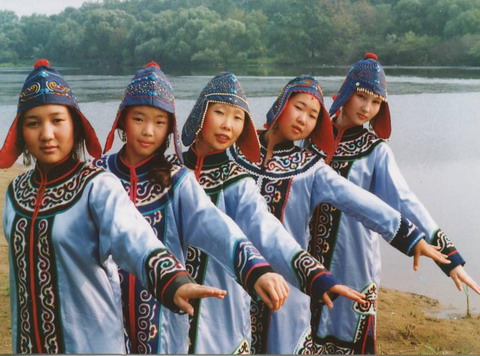


Bookmarks