

0














| Thumbs Up/Down |
| Received: 6,919/235 Given: 4,895/41 |

Con gusto hombre! plazer, gizona!Originally Posted by Spaniard 2.0



| Thumbs Up/Down |
| Received: 33,970/131 Given: 29,066/5 |
Sí, ví unas.
"Amicus Plato, sed magis amica veritas"
"Dimidium facti, qui coepit, habet: sapere aude, incipe."
| Thumbs Up/Down |
| Received: 33,970/131 Given: 29,066/5 |
Necesito pelazo para hacer de soldado de los tercios en una película situada en el siglo XVI, es lo único que me falta creo :
Me dejé bigote al quitarme la barba esta tarde, salí partiéndome el culo del baño, y en cuanto em vieron me dijeron que me quitara "eso" ahora mismo.
Last edited by gixajo; 03-08-2020 at 08:58 PM.
"Amicus Plato, sed magis amica veritas"
"Dimidium facti, qui coepit, habet: sapere aude, incipe."

| Thumbs Up/Down |
| Received: 8,909/29 Given: 5,292/29 |
Continuing with my genealogical research to support genetics, I have obtained the second surname of my paternal great-great-grandfather, which is
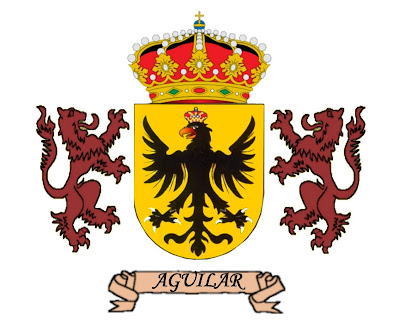
AGUILAR
Aguilar is a last name derived from the Latin aquilare, which means "place inhabited by eagles".
The origin of this lineage has to go back to the distant times of the Spanish Reconquest when the Christian armies occupied the lands that for centuries had been ruled by the Muslims. During the time of the Reconquest, the soldiers who were at the service of the Christian army used to be awarded with lots and portions of land, and elevated to the category of nobles, with which, their surnames were on record for the passage of history.
The first house of this lineage settled the town of Aguilar de Campoo. Very soon branches emerged that passed to Navarra, Aragon, Catalonia, Valencia, Rioja, Asturias and Galicia, creating many solar houses, which contributed to spreading the name in the mentioned regions.
Fray Pedro de Aguilar, Commander of Mallorca in the Mercedarian Order in 1317, came from the branch of Catalonia. In the 14th century an Aguilar family of merchants lived in Barcelona, specifically in Montcada street (the current Aguilar Palace, home of the Picasso Museum ), who in 1510 obtained the privilege of Honored Citizens of Barcelona. In Cardona, during the 14th century, a family of merchants settled, possibly related to the previous one. They moved to Barcelona in the following century, reaching the caballerato. The Aguilar de Organyà were lords of the place of Fígols. Noble families of this surname lived in the cities of Balaguer, La Seu d'Urgell and Torroella de Montgrí. In the 12th century, the Aguilar were Castilians from Malla and lords of the farmhouses of Belltall, Aguilar and Güells. Many knights of the family name Aguilar proved their nobility to enter the various Military Orders of Santiago, Montesa, Alcántara, Carlos III and San Juan de Jerusalem, doing it in the Hijosdalgo Room of the Royal Audience and Chancery of Valladolid and in the Royal Audience of Oviedo. It is one of the surnames of the 200 lineage knights who came to the reconquest of Seville with San Fernando. They held positions of Jury in the city council in diverse centuries. Don Alfonso de Aguilar, was mayor of Seville in the reign of the Catholic Monarchs. Of this family are the Great Captain Don Gonzalo Fernández de Córdoba and his brother Don Alonso de Aguilar, belonging to the Cordovan branch of the family. Sebastián Aguilar conquered Florida in 1563. Related to the Marquis of Donadío and Peílaflor.
https://es.wikipedia.org/wiki/Aguilar_(apellido)
Also I have obtained the second surname of my paternal great-grandmother who is
RAMÍREZ
Isabel Naranjo Ramírez (Paternal great-grandmother (c)) No reply
Paternal family photo (c) No reply
Ramírez is a surname of patronymic origin, that is, of patriarchal origin derived from the Christian name Ramiro; this last name means in Spanish "son of Ramiro". As every patronymic surname lacks a genealogical relationship with each other, so each Ramírez in the world does not have the same origin. Its influence extends from the Iberian Peninsula, throughout the American Continent and other parts of the world.
The suffix -ez is of Visigothic Germanic origin and is the patronymic way of indicating filiation. Both in Visigothic Spain, and in other Germanic cultures, it was common to form an individual's last name by adding the father's first name with one of the patronymic forms az, ez, iz or oz. In this way, paternal surnames such as Álvarez (son of Álvaro), López (son of Lope) and Rodríguez (son of Rodrigo), among others, are born; The Portuguese form of this surname is Ramires.
There are several theories about the origin of the last name Ramírez, but most genealogists agree that its origin is first due to the Visigothic people when they conquered part of Europe. One of the theories says that the last name Ramírez comes from the name Ramón, this in Germanic language. means "Notice" and "protector", coming from Reginmund of the ragin elements, equal to advice, advice, consultation, notification or notice, and Mund, which means protector. In this way it would spread from 406 d. C. in most of Europe in many surnames or names, among them the names and possible surnames of Raimundo, Raymonde, Raymundi, Raydan, Ramones, Rajmund, Raimunde, Raimonds, Raimo, Raimondas, among others, the saints of this derivation They are Ramón Nonato and Raimundo de Peñafort.
The most accepted theory anyway is the one that comes from the name Ramiro or Ramirus. This name is the Latinized form in the Visigothic language of ragin (read above) and mari (famous), while Ramón could mean warning or "protective advice". Ramiro would mean "famous notification", although in Spanish it means "Great judge" (Ramirus), and Raimundo "powerful protector". Anyway it is of Teutonic origin. History tells that Saint Ramiro, patron saint of the Ramírez family, was killed by Arian Visigoths in ca. 554 or 630 while singing the Nicene creed with his brothers.
It is a Germanic contraction of the name Ranimiro, of Visigothic origin, for Ranamêrs, which would mean (frog: wedge and mers: illustrious). Others take it from Radamir (rad: council, and miru: distinguished), although this last element could be of Slavic origin.
Noble houses of Ramírez
Façade of the Palazzo Ramírez di Montalvo.
Madrid solar house
The first solar house to use the last name Ramírez according to several authors, is the one founded in Madrid by Mr. Gracián (Garzia, García) Ramírez from the castle on the slopes of Rivas, on the banks of the Jarama River. This Mr. García was the first Governor, Mayor and Captain of Madrid, founder of the chapel of "Nuestra Señora de Atocha". Her son Juan Ramírez was at the service of Alfonso VI. Diego Ramírez, another descendant of Gracián (García) Ramírez, from Madrid, equally served King Fernando IV.
https://es.wikipedia.org/wiki/Ram%C3%ADrez
Last edited by Gallop; 04-05-2020 at 02:11 PM.
https://www.yfull.com/tree/E-BY7449/
E-V22 - E-BY7449 - E-BY7566 - E-FT155550
According to oral family tradition E-FT155550 comes from a deserter of Napoleon's troops (1808-1813) who stayed in Spain and changed his surname.
| Thumbs Up/Down |
| Received: 33,970/131 Given: 29,066/5 |
repeated.
Last edited by gixajo; 04-05-2020 at 06:25 PM.
"Amicus Plato, sed magis amica veritas"
"Dimidium facti, qui coepit, habet: sapere aude, incipe."
| Thumbs Up/Down |
| Received: 33,970/131 Given: 29,066/5 |
No hagas mucho caso de esas páginas de heráldica y genealogía generalistas, hay montones de orígenes simultáneos y casas solares y distintos escudos heráldicos relacionados con el mismo apellido.
Para saber exactamente esos datos se tus apellidos particulares tienes que hacer una investigación seria.
Hay casas solares de Ramírez en muchos sitios diferentes, y posiblemente (no necesariamente) si pudieras retroceder varios siglos atrás, igual tu apellido Ramírez es un apellido compuesto.
En Álava conozco al menos una casa solar de Ramírez, que comenté en un hilo sobre caballeros cruzados españoles, y en ese caso el apellido Ramírez está relacionado con la casa real Navarra más o menos de la misma época que la que esa página de genealogía generalista menciona del Ramírez que servía a Alfonso VI. Hay varios sitios en La Rioja, Álava y Navarra relacionados con esta misma familia.
"Amicus Plato, sed magis amica veritas"
"Dimidium facti, qui coepit, habet: sapere aude, incipe."
| Thumbs Up/Down |
| Received: 8,909/29 Given: 5,292/29 |
Estoy en ello, es un dato más.
Podría estar entroncado con la casa Real de Navarra, xd
Last edited by Gallop; 04-05-2020 at 06:07 PM.
https://www.yfull.com/tree/E-BY7449/
E-V22 - E-BY7449 - E-BY7566 - E-FT155550
According to oral family tradition E-FT155550 comes from a deserter of Napoleon's troops (1808-1813) who stayed in Spain and changed his surname.

| Thumbs Up/Down |
| Received: 3,717/14 Given: 2,897/0 |
Gallop, pon tu haplogrupete aquí:
https://docs.google.com/spreadsheets...gid=1797473836
| Thumbs Up/Down |
| Received: 1,396/121 Given: 487/62 |
De hecho, es curioso ver cómo los vascos de la alta Edad Media solían tener apellido no-vasco por el hecho de que heredaban como apellido el nombre del padre. Es decir, un Ramiro Fernandez de Erandio tendría un hijo llamado Gonzalo Ramirez de Erandio y su hijo se llamaría Fernando González de Erandio. No sé cuándo empezarían a aparecer apellidos en euskera propiamente dichos pero al menos en la época más antigua (romance-latín) solían ser apellidos castellanos como tb se puede comprobar con los fundadores de ciudades que eran Lopez de tal o cual.
| Thumbs Up/Down |
| Received: 33,970/131 Given: 29,066/5 |
Creo que la mayoría de los apellidos en Euskera hoy en día son los antiguos apellidos compuestos de patronímico castellano acabado en -z +toponímico en euskera, al que simplemente se le quitó el patronímico castellano . Hoy en día la mayoría de esos apellidos compuestos que quedan están en Álava.
Pero no es un fenómeno reciente ni exclusivo del País vasco, es algo que ocurrió en toda España, aunque igual en el resto de España había menos proporción de apellidos compuestos.
Lo de quitarse el patronímico castellano en vascos, podría estar relacionado con lo que hablamos un día de la Vizcainía y la consideración de buena cuna de los naturales de la zona del Pías Vasco actual, porque un apellido claramente vasco, significaría buena sangre. Digo esto porque la hidalguía por origen era practicamente universal en las actuales provincias de Vizcaya y Guipúzcoa, que es donde no hay apellidos compuestos en números semejantes a los que sí hay en gente nativa de Álava.
Es solo una teoría propia, no he leído nada semejante por ahí, igual existe gente que haya planteado esto antes, pero no es muy descabellada.
"Amicus Plato, sed magis amica veritas"
"Dimidium facti, qui coepit, habet: sapere aude, incipe."
There are currently 2 users browsing this thread. (0 members and 2 guests)
 Posting Permissions

 Reply With Quote




Bookmarks