

0


| Thumbs Up/Down |
| Received: 429/0 Given: 618/0 |

The departments with the largest values of local genetic differentiation—measured in Fst per 30 km—are the three departments at the western end of Brittany as well as the Vendée department. In summary, both LD and local differentiation suggest that local effective population size is smaller in the western part of Brittany and local differentiation points to a specific pattern in the Vendée Department.(...)Originally Posted by Creoda

Patterns of genetic variation are partly generated by genetic drift defined as the random fluctuations of allele frequencies. When two populations diverge, genetic differentiation increases because of genetic drift. The smaller the effective population size, the larger the effect of genetic drift. We argue that the larger values of local Fst and of LD that were found in Brittany are explained by the enhanced effect of genetic drift in populations of lower effective population size.
https://www.ncbi.nlm.nih.gov/pmc/articles/PMC4795055/
To investigate fine-scale structure in Western France, I assembled genotype data for 3,234 individuals whose grandparents were born within two administrative regions, Brittany and Pays de la Loire. To under- stand the distribution of population diversity in Western France , we computed measures such as LD decay and length of ROH across the different regions.
LD decay was calculated for two regions (Figure 3.5). Like in [99], LD is higher in Brittany Region than in Pays de la Loire. I corroborated LD decay results with length of runs of homozygosity. Length of runs of homozygosity (ROH) gradually increases towards the end of Brittany Peninsula. We observe that visually at the departmental level (Figure 3.6 a) as well as in the linear regression models. We regressed longitude, latitude and average distance between grandparents’ birthplace on the length of ROH of each individual (Table 3.2). Estimated coefficients suggest that length of ROH and longitude are negatively correlated, thus length of ROH increase westwards. Next we regressed distance between individual birthplace and the westernmost commune in Brittany (Le Conquet) and average distance between grandparents’ birthplace on the length of ROH (Table 3.3). Estimated coefficients reveal that the length of ROH increases when the distance to westernmost point of Brittany decreases. Both LD and ROH results suggest smaller effective population size in Brittany. Finer scale of arrondissements for ROH allows to notice local phenomena, in particular near Brest, St. Malo and Cholet (Figure 3.6 b).
http://www.theses.fr/2019NANT1007

Last edited by J.S.; 07-01-2021 at 07:23 PM.
| Thumbs Up/Down |
| Received: 429/0 Given: 618/0 |
delete
Last edited by J.S.; 07-01-2021 at 09:40 PM.










| Thumbs Up/Down |
| Received: 546/5 Given: 752/18 |
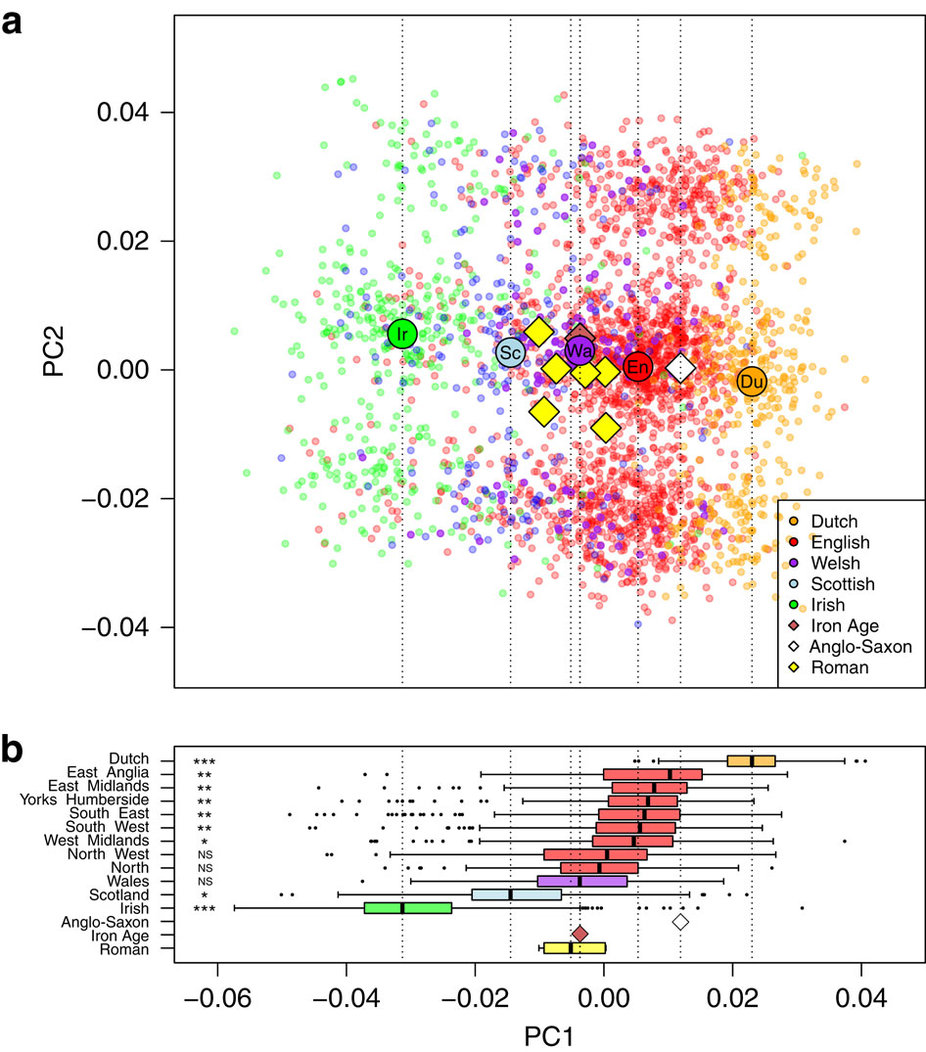
It's balanced out now. Since the industrialisation of the 19th century people from all across the British Isles moved to South-East England. I do expect that the natives of South-East England to be overwhelmingly Germanic. At least the men.





| Thumbs Up/Down |
| Received: 17,266/194 Given: 8,168/117 |
That's true, also non-Germanic European immigrants, which makes East Anglia and probably the East Midlands the most Anglo-Saxon now.


| Thumbs Up/Down |
| Received: 52,620/1,011 Given: 43,526/788 |
What about Yorkshire?
| Thumbs Up/Down |
| Received: 546/5 Given: 752/18 |
Northern England seems solidly Anglo-Danish. The natives pass for Danes, Dutch and Northern Germans easily.
| Thumbs Up/Down |
| Received: 17,266/194 Given: 8,168/117 |
Perhaps, but Yorkshire was the heart of the Danelaw, so it is more Germanic than specifically Anglo-Saxon, whose entry point was SE Eng/East Anglia, and whose influence tailed off in the North. In more recent centuries Yorkshire has also been heavily industrialised and received many Irish and Scots, that have assimilated.
| Thumbs Up/Down |
| Received: 17,266/194 Given: 8,168/117 |
For a long time Northumbrians (Northern English) preferred Danish overlords to Saxon ones in the South! That North-South divide has never gone away.
| Thumbs Up/Down |
| Received: 546/5 Given: 752/18 |
Yeah, I know of Cnut, Siefried and Halfdan. They became Danish overlords in Southern Northumbria shortly after the invasion of the Great Heathen Army. It was said that Ubba was described as a descendant of a Frisian benefice. Restore the North-Sea Empire
| Thumbs Up/Down |
| Received: 17,266/194 Given: 8,168/117 |
Possible sneak preview of the paper

There are currently 1 users browsing this thread. (0 members and 1 guests)
 Posting Permissions

 Reply With Quote
Bookmarks