

0







| Thumbs Up/Down |
| Received: 11,115/213 Given: 10,109/550 |

Do we have any good medieval Norman samples?




| Thumbs Up/Down |
| Received: 23,534/742 Given: 20,425/1,183 |
NO3423, Anglo-Saxon from Northumbria dated to 650-910 AD (so already Middle AS period) is still not similar to modern English, but much more Germanic:Originally Posted by Creoda

^^^ G25 scaled coordinates.Code:England_Saxon:NO3423,0.129758,0.13405,0.068259,0.062339,0.0397,0.017012,0.004465,0.002077,0.001227,-0.007107,-0.007795,0.001499,-0.010852,-0.010459,0.027823,0.005569,-0.014212,0.004561,-0.000126,0.005002,0.009982,0.002473,0.002465,0.015183,0.001916
Maybe there was a large spread in the Northumbrian society at that time with some people still being almost 100% autosomally Briton (even if culturally already Anglo-Saxon), while some others being like NO3423. And everything in-between.
Last edited by Peterski; 02-01-2022 at 10:16 AM.


| Thumbs Up/Down |
| Received: 7,371/127 Given: 2,702/43 |
Cranial studies of the oldies show that the Anglo-Saxons were still largely "Anglo-Saxon" as late as the 9th century AD, so I'm inclined to believe that the Vikings still encountered very Germanic individuals in their early raids. Could the Viking invasions have stimulated the union of Saxons and natives? Dunno, but it is possible.
| Thumbs Up/Down |
| Received: 23,534/742 Given: 20,425/1,183 |
Yes it is possible. BTW I'm surprised that the Welsh did not unite with the Vikings in order to reconquer at least some of formerly Briton lands from the Anglo-Saxons.
| Thumbs Up/Down |
| Received: 7,371/127 Given: 2,702/43 |
The Britons seem to have lost their impetus after tasting the niceties of Roman civilization, like all other Roman provincials. No wonder western Europe turned into a Germanic battlefield in the early Middle Ages, with the rest being not much more than onlookers and food producers for their successive Germanic lords.




| Thumbs Up/Down |
| Received: 17,266/194 Given: 8,168/117 |
Yes, I'd expect there to be more ancestral variance until later in the Middle Ages.
Eastern English are seemingly not much more Brittonic drifted than those Anglo-Saxon era samples, just more Southern.
The homogenisation of British population structure through admixture
In contrast to the gentle gradient of ancient Irish variation, British and continental individuals show a
more punctuated distribution along PC2 (Fig. 4.6B-C), forming two clear clusters at both ends of modern
British variation. Anglo-Saxons fall with southeastern English variation in this and all other PCs
considered, alongside a Nordic Iron Age sample, reflecting the large genetic contribution of Germanic
migrations to this part of the island (Leslie et al. 2015; Schiffels et al. 2016). Iron Age Britons comprise
another tight grouping at the opposite end of British variation, emphasising the admixed nature of the
modern population (Leslie et al. 2015; Martiniano et al. 2016; Schiffels et al. 2016). Early snapshots of
continental introgression events may be represented by two samples that fall midway between the two
groups, one from an Anglo-Saxon context (O3), which was reported as admixed in the original study
(Schiffels et al. 2016), and the second from a Roman British population (6DT23), another member of
which was demonstrated to be of likely Middle Eastern origin (Martiniano et al. 2016). Notably, no Irish
Iron Age samples are seen to fall into this region of the PC space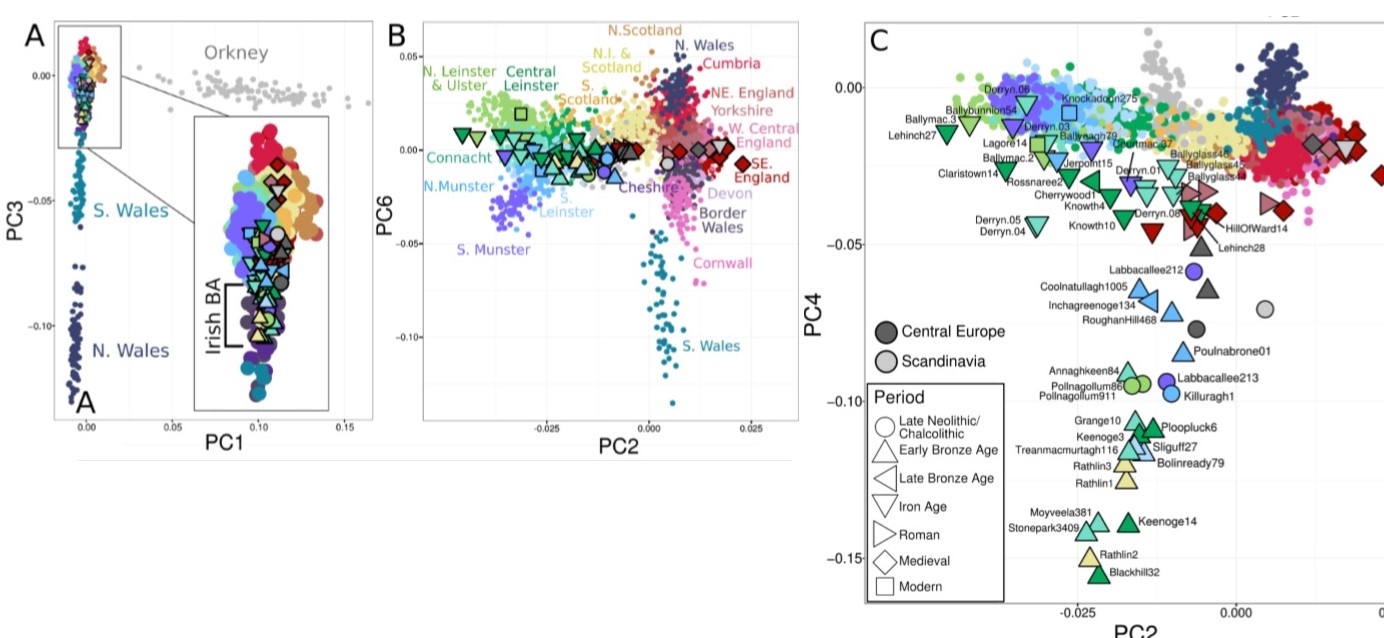
| Thumbs Up/Down |
| Received: 17,266/194 Given: 8,168/117 |
They did at Brunanburh (modern Cheshire), but they failed, and the Kingdom of England was solidified.
https://en.wikipedia.org/wiki/Battle_of_Brunanburh
| Thumbs Up/Down |
| Received: 23,534/742 Given: 20,425/1,183 |
Thanks for the info, but Strathclyde was not located in present-day Wales.
It seems that kingdoms from present-day Wales did not participate.
Edit:
Actually maybe the Kingdom of Gwent participated too.
| Thumbs Up/Down |
| Received: 17,266/194 Given: 8,168/117 |
They were Welsh though, those distinctions didn't exist yet, not to the English anyway. The King of Strathclyde was Owain ap Dyfnwal, couldn't get any more Welsh than that. Wales is simply the Brythonic lands that weren't conquered (until later).
The main reason the Welsh in Wales didn't bother the English much was because of Offa's Dyke, built in the 8th century, separating Wales from Mercia.
Last edited by J. Ketch; 02-01-2022 at 12:48 PM.
| Thumbs Up/Down |
| Received: 17,266/194 Given: 8,168/117 |
I'm not sure how Romanised/'Civilised' most of the Britons were though, it surprised me before how small a percentage of the population of Roman Britain was urban, and they would have been demographically hardest hit by Roman withdrawal. Actually it's remarkable how un-Romanised the known sub-Roman Britons were and what little legacy there was from 300+ years of colonisation, almost as remarkable as how un-Celtic the early English were.
There are currently 1 users browsing this thread. (0 members and 1 guests)
 Posting Permissions


 Reply With Quote
Bookmarks