

6








| Thumbs Up/Down |
| Received: 17,266/194 Given: 8,168/117 |

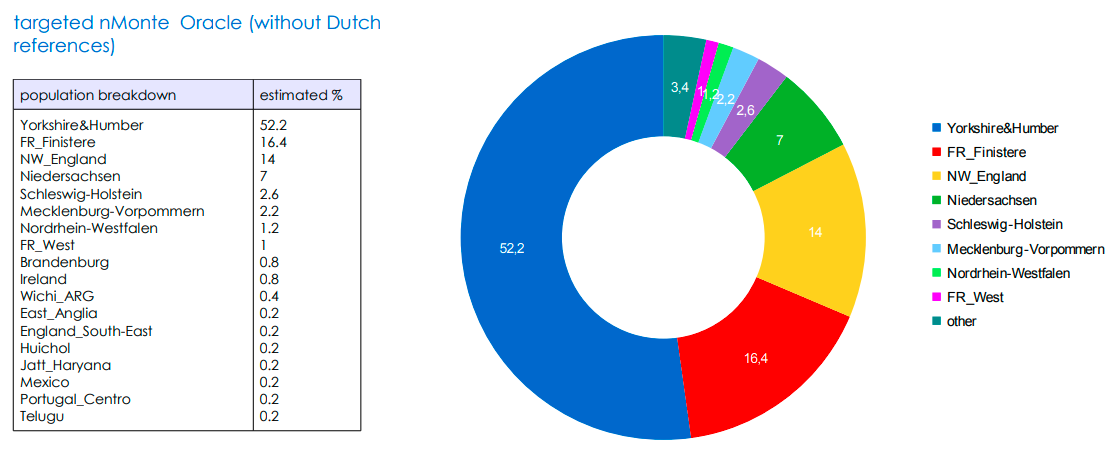
A lot of what I've been saying for a while. A decent amount of Norman French mediated influence is needed to explain England's current position in PCAs, not just Briton + Germanic, although 43% in parts of the SoutheastOriginally Posted by Token

That sounds like a bit much based on my modelling, but I speculated up to 20%. I assume some of that must be Flemish, who've had a decent amount of influence in England since the middle ages, or perhaps earlier undetected ancestry from Belgae or Romans in SE Britain that is different from the other Iron Age British references.
Huge news though, proves the decades of mainstream non-migrationist revisionism to be full of crap. And proves again that 'Brits' are not all the same despite what some people seem to think, English and Insular Celts have quite different ancestry.
Spoiler!
| Thumbs Up/Down |
| Received: 17,266/194 Given: 8,168/117 |
Spoiler!
| Thumbs Up/Down |
| Received: 17,266/194 Given: 8,168/117 |
Norb plots like a Fleming, which in light of this study makes sense, as SE England like Flanders/South Dutch looks more Germanic + Gaulish than Germanic + Brittonic.
But much of that Gaulish blood has to be pre Anglo-Saxon IMO, even though there's not much evidence of it yet. I believe the Belgae replaced the earlier Celtic Southern Britons to some extent.
Spoiler!


| Thumbs Up/Down |
| Received: 7,371/127 Given: 2,702/43 |
Admixture proportions for modern-day British. The "Anglo-Saxon" detected among Irish and northern Scots must be largely Viking. Anglo-Saxon ancestry is as low as 25% in Cornwall and as high 50% in eastern England. By the way, let's all laugh at the vast majority of archaeologists who thought that the Anglo-Saxons were just a minority in England compared to native Britons.

| Thumbs Up/Down |
| Received: 7,371/127 Given: 2,702/43 |
Oh, didn't see that you had posted it already
| Thumbs Up/Down |
| Received: 17,266/194 Given: 8,168/117 |
I missed this quote earlier from JonikW:
Not sure what to make of calling them Franks, but the French IA types existing alongside Anglo-Saxons and Celtic Britons? That's a surprise, and perplexing.Conclusion bullet points:
Significant numbers of graves with CNE (Anglo-Saxon) ancestry;
No sex bias to ancestry;
But post-mortem treatment seems to emphasise female artifacts and brooches;
There are significant regional and local patterns;
A significant factor in this migration is the family, providing a vehicle for integration or separation.
Question and answers: Question: are the “French IA” signals actually from the Franks? Response: the only category that really matters is the WBI (British) women. They are the lower status with a “slightly lesser place” in society. But the individuals are not thinking of themselves as AS. However, the IA French ancestry “exists alongside the CNE and WBI” and you’re just as likely to have it in a WBI sample. But “probably, yes” the IA French signal is from the Franks.
Or if it exists equally in WBI (Celtic Briton) and CNE (Anglo-Saxon) then it's just a part of sub-Roman British ancestry?
Last edited by J. Ketch; 06-25-2022 at 10:50 PM.
Spoiler!


| Thumbs Up/Down |
| Received: 17,635/52 Given: 18,191/104 |
This thread has been interested to read, given my own ancestry.
| Thumbs Up/Down |
| Received: 17,266/194 Given: 8,168/117 |
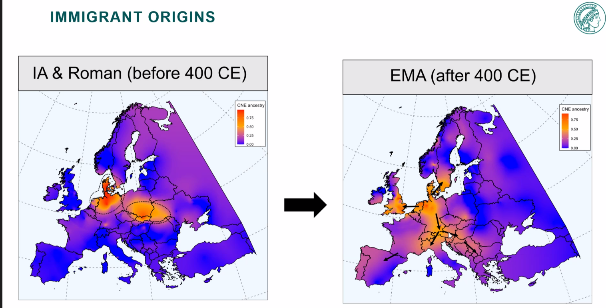
Spread of CNE ancestry (Anglo-Saxon like) in Europe during and after the Roman Empire, courtesy of JonikW again.
Thoughts?
Spoiler!
| Thumbs Up/Down |
| Received: 7,371/127 Given: 2,702/43 |
CNE seems to peak in the Jastorf-Kultur area in the Iron Age, which was probably Proto-Germanic. The arrow from the continent to southern Sweden is intriguing, I'd tend to think it was the other way around based on the evidence of "Proto-Danes" coming from Sweden to fill the empty space left by the Anglo-Saxons after the great migration. Northern Italy with more Germanic ancestry than northern France also looks weird.



| Thumbs Up/Down |
| Received: 30,090/159 Given: 35,261/35 |
That's what the Viking paper concluded but I don't know how much sense that makes as there was obviously English in both Ireland and Scotland. It would have been interesting if they sampled Dublin.
Here's the quote from the Viking paper.
The French component is really interesting as well. It looks like southeast England has had a high amount of immigration from the Continent even after the Anglo-Saxons arrival. Really looking forward to this paper coming out in a few weeks' time.From this, we can see the spread of ancestry during and around the Viking era:
● UK populations have all received high ‘Denmark’ ancestry. Although Anglo-Saxon and Danish Viking ancestry are hard to distinguish, Viking-era Danes have too much “Sweden” ancestry to have contributed more than around 6% ancestry into England, whereas they could plausibly have contributed all (up to 16%) of the Scottish and Irish signal. Anglo-Saxon samples are needed to explore this further.
● The ‘Norway’ ancestry signal in the UK cannot be explained via the Danish or Anglo-Saxon contribution. These fractions (4% in England, Scotland, and Ireland, 3% in Wales) likely correspond to the Norwegian Viking legacy in Britain
Last edited by Grace O'Malley; 06-26-2022 at 10:27 AM.
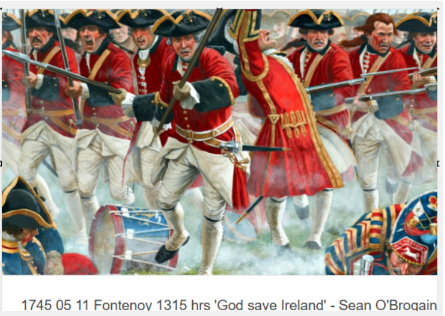
The Irish Brigade's battle cry at Fontenoy, "Cuimhnigí ar Luimneach agus ar feall na Sasanaigh," translates to "Remember Limerick and the treachery of the English." After seeing the devastation caused by the Irish Brigade, the Duke of Cumberland reportedly remarked, "God curse the laws that made those men our enemies".
There are currently 1 users browsing this thread. (0 members and 1 guests)
 Posting Permissions


 Reply With Quote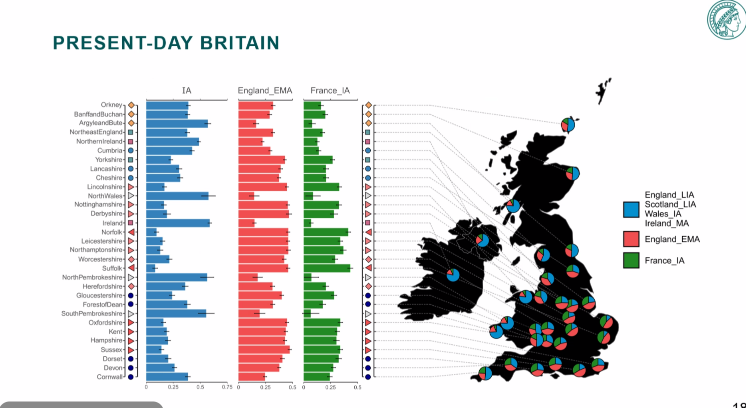
Bookmarks