

0


| Thumbs Up/Down |
| Received: 888/22 Given: 377/58 |

https://journals.plos.org/plosone/ar...l.pone.0058552Originally Posted by Peterski

on this PCA in particular, central russians are way closer to Italians than to Northern Russians
https://journals.plos.org/plosone/ar...e.0058552.g003
The thing is you can setup PCA in any way you want. It's not objective, unlike F statistics.
--

| Thumbs Up/Down |
| Received: 2,867/45 Given: 2,767/89 |
How????
| Thumbs Up/Down |
| Received: 888/22 Given: 377/58 |
PCA is very easy to manipulate. I can make a PCA showing anything I want.
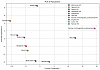
Here's a PCA I made using G25 coordinates and only 3 anchors, Volga_IA, Latvian, and Mbuti. I set it up this way to maximize the distance between Northern Russians and other populations in europe, and minimize the differences between northern russians and any population "east" of the Urals. This PCA shows northern russians clustering closer to Yakuts than to central russians. Quite profound stuff.
I am not a big fan of PCA based calculators and especially using something this unstable and manipulatable to compare how diverse different ethnicities are. Of course using K36, Germans will be more "diverse" than Russians. Russian diversity is in the Eastern Europe - Volga Ural spectrum. Only 2 anchors. German diversity hits much more anchors. "French" "North Sea" "North Atlantic" "Iberian" "East Central European" and many more anchors. The same can be said of the anchors in G25. Although in G25, Russians are still the most diverse europeans with a max distance of 0.09 between russian Leshukonsk and Belgorod. I'm pretty sure the distance from Danish to Spanish is like 0.08...
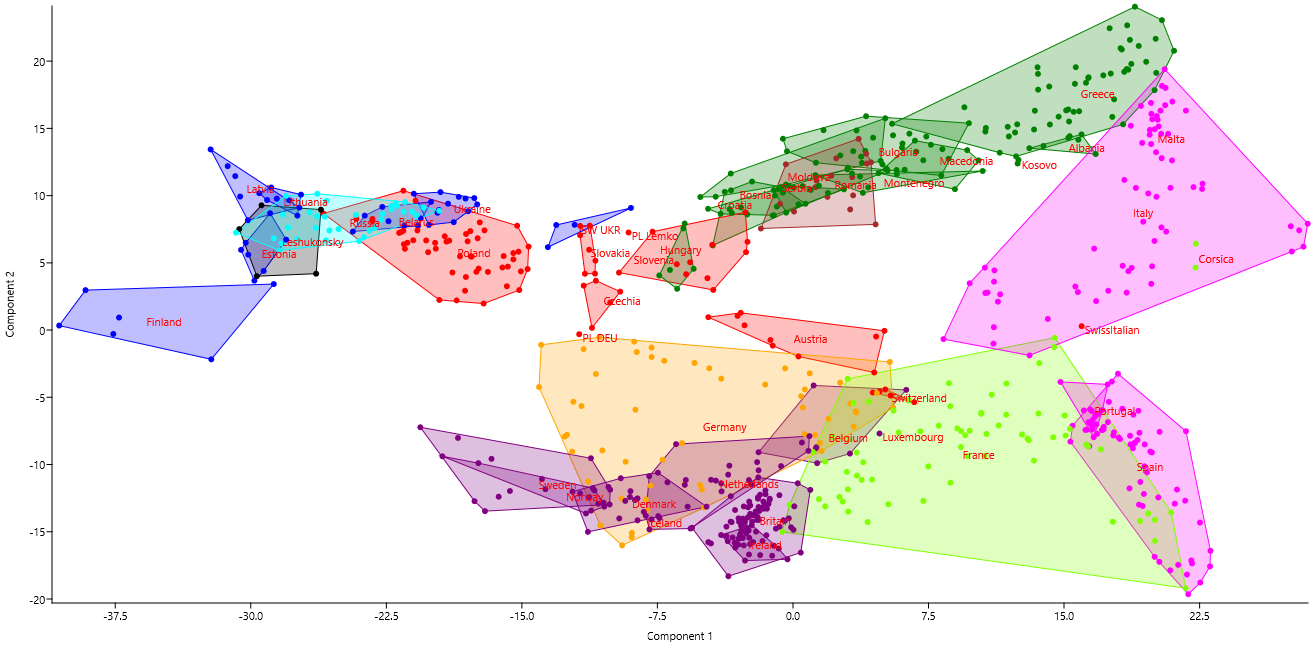
Here's an F2 based PCA system I made with 3 anchors, which are Sardinian, Mansi, and Lithuanian. This is an "intellectually honest" way to envision european ancestry.
--
There are currently 1 users browsing this thread. (0 members and 1 guests)
 Posting Permissions


 Reply With Quote
Bookmarks